Here is something I have been sitting with for years, and I suspect you have too, even if you have never put it into words:
Millions of people chant Vishnu's name every single day. Tirupati's Tirumala hills receive more visitors annually than the Vatican. The Vishnu Sahasranama has been recited continuously for over three thousand years. And yet — most devotees, even deeply sincere ones, cannot answer this question with confidence:
"What does Lord Vishnu actually do on your behalf when you call his name? And how does the way you call it change what happens?" — A question posed at a Vishnu Sahasranama pravachan, Srirangam, 2019
That gap between devotional practice and devotional understanding is exactly why this guide exists. Not to replace your faith — but to deepen it. Because when you understand why you do what you do, every act of worship becomes richer, every chant becomes more alive, and every moment of difficulty becomes easier to surrender.
By the time you finish reading this complete guide, you will have the answer to that question. And to many more you did not know you had.
Devotion without understanding can become mere habit. Worship without knowledge is like watering a plant in the dark — you may be doing it right, or you may be slowly harming it. This guide does not ask you to intellectualise your faith. It asks you to illuminate it.
Who Is Lord Vishnu? Understanding the Preserver God
If you ask ten people who Lord Vishnu is, you will get ten different answers. A child might say "the one with the blue skin and four hands." A scholar might quote the Vishnu Purana's definition. A grandmother in Tirupati might simply close her eyes and say, "He is everything." All of them are correct. That is the nature of Vishnu — he contains multitudes.
Let us build the picture layer by layer, the way light slowly reveals a temple at dawn.
The Name Itself — What "Vishnu" Means
The name Vishnu comes from the Sanskrit root vish, meaning "to pervade" or "to enter into." The Vishnu Purana defines him this way: "He who pervades the entire universe is Vishnu." This is not poetry. It is a theological statement about the nature of reality — that the divine is not somewhere far away in the sky, waiting to be reached. It is already here, woven into every atom of existence.
This understanding changes prayer. When you call Vishnu's name, you are not sending a message to a distant address. You are recognising something already present in you and around you. The Sanskrit term for this recognition is anusandhana — tracing the divine presence that was never absent.
The Essential Attributes: What Makes Vishnu, Vishnu
According to Vaishnava theology, Lord Vishnu possesses six supreme qualities (known as the Shad-guna or Bhagavat Guna) in their absolute and complete form:
| Quality (Sanskrit) | Translation | What It Means for Devotees |
|---|---|---|
| Jnana | Omniscience | He knows your situation completely — nothing needs to be explained, only felt |
| Shakti | Omnipotence | He has the power to do what no other being can — including granting liberation |
| Bala | Supreme Strength | He bears the weight of the entire universe without effort or fatigue |
| Aishvarya | Sovereignty | He is the ruler of all — yet bows to his devotees' love |
| Virya | Immutability | He is never diminished, never depleted, never corrupted by the world |
| Tejas | Radiant Splendour | His very presence dissolves darkness — both literal and metaphorical |
So what? you might ask. Why does this list matter for daily life? Because every attribute in that table is a promise. A promise that the one you are turning to when life becomes difficult is genuinely equipped to help — not symbolically, but actually. When you understand that Vishnu's jnana means he already understands your situation better than you do, your prayers change from anxious petitions to trustful surrender. That is a significant shift.
Vishnu as the Cosmic Preserver — What Does "Preservation" Actually Mean?
The word "preserver" can sound passive — like someone holding a jar of pickle to prevent spoilage. But Vishnu's preservation is dynamic, intelligent, and deeply personal.
In the Vaishnava cosmological framework, the universe goes through cycles of creation (by Brahma), preservation (by Vishnu), and dissolution (by Shiva). During the preservation phase — which is the immensely long period in between creation and dissolution, the one we are living through right now — Vishnu actively maintains cosmic order.
He does this in three ways:
- By sustaining dharma — the moral and cosmic law that holds the universe in balance
- By personally intervening — descending as avatars whenever dharma is severely threatened
- By being present in all living beings as the inner witness (antaryami), guiding their spiritual evolution
The practical implication of this for a devotee is profound: Vishnu is not just the god you call on during festivals. He is the intelligence behind your conscience, the order behind the seasons, and the reason your heart continues beating through the night while you sleep.
Temple sculptures often depict Vishnu's cosmic (Vishvarupa) form, showing that the entire universe exists within him — an idea rooted in the Bhagavad Gita's eleventh chapter.
The Relationship with Goddess Lakshmi — A Love Story and a Theology
You cannot understand Vishnu without understanding Lakshmi. The two are inseparable — not just iconographically, but theologically.
Lakshmi is Vishnu's eternal consort (divine spouse). She represents Shakti — the active power through which Vishnu's grace flows into the world. In Sri Vaishnava theology, she is the purushakara — the divine mediator who softens Vishnu's unapproachable majesty and makes his grace accessible to ordinary souls. When you feel unworthy to approach God directly, you approach through Lakshmi.
This is why Vishnu temples almost always have a Lakshmi shrine, and why the greeting "Sri Venkateswara" or "Sri Ranganatha" always begins with "Sri" — a name for Lakshmi. She is always mentioned first, as a mark of honour and as a reminder that divine grace comes through her.
For devotees, this has a beautiful personal application: when life gives you abundance — whether in wealth, relationships, health, or peace of mind — that abundance is Lakshmi's expression of Vishnu's grace. Gratitude toward one is gratitude toward both.
Decoding Lord Vishnu's Sacred Symbols — Nothing Is Decoration
One of the most common mistakes even devoted Hindus make is seeing Vishnu's iconography as artistic convention — as if someone decided thousands of years ago that a blue, four-armed figure carrying a conch and a wheel simply "looked good." The truth is the exact opposite. Every single element of Vishnu's appearance is a compressed theological teaching. Once you learn to read it, looking at his image becomes a meditation.
The Four Arms and What They Hold
Vishnu's four arms represent his ability to act simultaneously in all four directions of existence — past, present, future, and the eternal now. In each hand, he carries one of four sacred objects:
| Object | Sanskrit Name | What It Represents | The "So What" |
|---|---|---|---|
| Conch Shell | Shankha (Panchajanya) | The primordial sound of Om; the origin of all creation; the call to consciousness | When you hear a conch blown at the start of puja, you are hearing the sound of creation itself. It is not a sound effect — it is a reminder that the divine was here before you arrived. |
| Spinning Discus | Sudarshana Chakra | The mind in perfect mastery; the wheel of time; the weapon that cuts through illusion (maya) | The discus is always spinning — which means Vishnu's consciousness is never still, never inattentive. His awareness circles the universe continuously. Nothing falls through the cracks. |
| Mace | Kaumodaki Gada | The power of knowledge; the strength that defeats ego; the principle of just punishment | When life seems to knock you down, this attribute of Vishnu is working. The mace does not strike the innocent — it corrects what has gone out of alignment. |
| Lotus Flower | Padma | Spiritual liberation (moksha); purity in the midst of the material world; beauty arising from mud | The lotus grows in muddy water but is never touched by the mud. This is what Vishnu offers you: the possibility of living in the world without being stained by it. |
The Blue Skin — Why This Colour Was Chosen
This is one of those questions where the first answer you receive is rarely the deepest one. Most people will say "Vishnu is blue because he is associated with water and sky." That is true, as far as it goes. But the tradition goes deeper.
In Vedic symbolism, blue is the colour of infinity — the sky has no edge, the ocean has no visible bottom. When you try to point to where blue ends and something else begins, you cannot. This is the nature of Vishnu: he has no edge, no limit, no boundary where he ends and something else begins.
There is also a more subtle meaning. Blue is the colour absorbed by an object that reflects all other colours back to you. A blue object, in other words, takes in all light and transforms it. Vishnu, in the same way, absorbs all the suffering, all the confusion, all the darkness that devotees bring to him — and returns it transformed as grace.
Personal reflection: I remember sitting in the inner sanctum of the Ranganathaswamy temple in Srirangam for the first time as a teenager. The air was thick with camphor smoke. The priest removed the cloth from the deity's face. And for the first time, I understood why the deity's skin is blue — it was the colour of something that has absorbed entire oceans of human sorrow and remained utterly calm. That is a theology you cannot get from a textbook.
The Yellow Silk (Pitambara) — A King's Garment
Vishnu is typically shown wearing brilliant yellow silk, known as Pitambara (pita = yellow, ambara = garment). Yellow in the Vedic tradition is the colour of knowledge, of gold refined by fire, of that which survives purification. Yellow is also the colour associated with the element earth — Vishnu wears the earth itself as a garment, symbolising that the material world is his costume, worn lightly and removed with ease.
The Shrivatsa Mark and the Kaustubha Gem
On Vishnu's chest, you will find two iconic marks. The first is the Shrivatsa — a curl of hair, sometimes depicted as a mark or symbol, that represents the eternal home of Goddess Lakshmi. She dwells on his chest, meaning that wherever Vishnu is, his grace and abundance (Lakshmi) are there too.
The second is the Kaustubha Gem — a priceless jewel that emerged from the churning of the cosmic ocean (Samudra Manthan). It represents the soul (atman) — the most precious thing in existence, born from the deep churning of cosmic experience. Vishnu wears your soul on his chest. That is how close he holds every living being to himself.
The symbolic interpretations in this section are drawn from the Vishnu Purana (Chapters 6–9), the Narayana Upanishad, and the authoritative commentaries of Vedanta Deshika (13th–14th century CE) and Pillai Lokacharya. These are not folk interpretations — they come from the philosophical heart of the Sri Vaishnava tradition.
Lord Vishnu in the Trimurti — Understanding the Cosmic Role
Here is something I want you to notice: every major religion with a concept of God wrestles with the same question — how can one God be simultaneously the source of creation, the sustainer of life, and the agent of endings? Hinduism's answer is the Trimurti — three aspects of the one divine reality, expressed through three cosmic personalities.
This is where most explanations stop, and where the real conversation should begin. The Trimurti is not a committee of three gods taking turns. It is one reality expressing itself in three modes that operate simultaneously at all times.
Why Is Vishnu the Preserver — And What Does That Cost Him?
Brahma creates, but Brahma is not worshipped much in temples — there is only one major Brahma temple in India, at Pushkar. Shiva destroys, but destruction in Hindu philosophy is ultimately liberation, a breaking of the old shell. But Vishnu preserves — and preservation, when you think about it, is the most demanding role.
To preserve means to intervene. To prevent. To hold together. To come down again and again into the mess of human history — as a fish, as a boar, as a warrior prince, as a charioteer — and to fix what has broken, without forcing anyone's free will. This is the burden Vishnu carries willingly. And unlike the other aspects of the Trimurti, Vishnu alone takes on physical form in the world out of love, not necessity.
That is the Vaishnava understanding of why Vishnu is the appropriate object of devotion (bhakti): because he alone demonstrates that God is willing to get his hands dirty — again and again — out of love for his creation.
In fairness, the Shaiva tradition (followers of Shiva) would argue that Shiva's role as destroyer-transformer is the most compassionate of all — for what is more loving than removing what causes suffering? The Shaiva Agamas present Shiva as the supreme personal God with equal depth. Both traditions are valid expressions of deep Hindu spirituality. At BhaktiBharat, we present the Vaishnava view because this is a Vishnu-focused guide — not because other paths are lesser.
The Transformation Arc: From Confusion to Clarity
When you make this shift — from cultural familiarity to theological understanding — your entire relationship with Vishnu changes. He stops being a fixture in the family altar and becomes a living, present reality that you interact with consciously.
The Ten Avatars of Lord Vishnu (Dashavatara) — The World's First Theory of Evolution?
Before we go through the ten avatars one by one, I want to share something that never fails to stop people in their tracks when I mention it at spiritual gatherings:
The sequence of Vishnu's ten avatars follows a pattern that eerily mirrors the scientific theory of biological evolution. The first avatar is a fish (aquatic life). The second is a tortoise (amphibious). The third is a boar (early land mammal). The fourth is half-man, half-lion (primate-human transition). The fifth is a dwarf (short, primitive human). The sixth is a warrior using primitive weapons. The seventh is a perfect man bound by strict dharmic rules. The eighth and ninth are perfect humans who transcend those rules through love. The tenth has not appeared yet.
This parallel was first pointed out seriously by the theosophist Helena Blavatsky in the 19th century and has since been discussed by scholars including Bal Gangadhar Tilak. I am not claiming the Puranas "predicted" evolution — that would be intellectually dishonest. What I am saying is that the ancient seers of India had an extraordinary intuition about the progression of consciousness through increasingly complex forms. That deserves more than a footnote.
The Word Dashavatara — Unpacking It
Dasha means ten. Avatar comes from the Sanskrit root avatarana — "descent." An avatar is not a divine disguise. It is a genuine descent of Vishnu's consciousness into a particular form, in a particular time, for a particular purpose. The Bhagavata Purana (11.4.1–2) explains: "Whenever there is a decline of righteousness and a rise of unrighteousness, I send forth myself." This is Vishnu speaking in his own voice — taking personal responsibility for the state of the world.
All Ten Avatars — Stories, Meanings, and What They Teach
Vishnu appeared as a great fish to warn the sage Manu of an impending cosmic flood, and to recover the stolen Vedas from a demon. The world's wisdom was in danger of being lost — Vishnu became what could survive in the new world to preserve it. Lesson: Wisdom is worth protecting at any cost.
When gods and demons churned the cosmic ocean for the nectar of immortality, the churning rod (Mount Mandara) began to sink. Vishnu became a cosmic tortoise and supported the mountain on his back for thousands of years. Lesson: Even the most strenuous effort needs a firm foundation.
The demon Hiranyaksha dragged the earth (personified as Bhudevi) to the bottom of the cosmic ocean. Vishnu became a giant boar, fought the demon across cons of time, and lifted the earth on his tusks from the depths. Lesson: The earth and its life are worth saving — no depth is too deep for divine love.
When the tyrant Hiranyakashipu earned a boon making him immune to death by man, beast, weapon, inside or outside, day or night — Vishnu appeared at twilight in a doorway as a half-man, half-lion, and destroyed him with his claws. Lesson: Divine love for a devotee (Prahlada) transcends every limitation.
The generous demon king Bali had conquered all three worlds. Vishnu appeared as a dwarf brahmin and asked for "three footsteps of land." When Bali agreed, Vamana grew to cosmic proportions, covered all creation in two steps, and placed his third step on Bali's head — sending him to the underworld with honour. Lesson: Ego, even generous ego, must eventually bow.
When the warrior class (Kshatriyas) became corrupt and oppressed brahmins, Vishnu appeared as a brahmin warrior with an axe, and purged the earth of this corruption twenty-one times over. Lesson: Righteousness must be defended, sometimes ferociously.
To defeat the ten-headed demon Ravana who had abducted Sita, and to demonstrate the ideal of dharmic kingship, Vishnu became Rama — a prince who upheld duty above personal desire at every turn, even when it cost him everything he loved. Lesson: Dharma can coexist with love, but when they conflict, the truly great choose dharma.
The most beloved of all Vishnu's forms, Krishna came to defeat Kamsa, guide Arjuna through the Mahabharata war, and deliver the Bhagavad Gita — the most profound spiritual text ever composed. Lesson: Love is not a departure from dharma; it is dharma's highest expression.
This avatar is interpreted variously across traditions. Some see it as an acknowledgment of Siddhartha Gautama's divinity; others see it as Vishnu appearing to "delude" demons into abandoning Vedic violence. Lesson: Truth appears in unexpected forms.
The Kalki Purana describes Vishnu's final avatar as a warrior on a white horse, appearing at the end of the current Kali Yuga to defeat the forces of total darkness and usher in a new Satya Yuga (Golden Age). Lesson: Even the darkest night has a dawn.
Watch: The Dashavatara of Lord Vishnu — Stories, Symbolism and Modern Relevance (BhaktiBharat Recommended)
The Evolutionary Progression — A Data View
Chart: Relative complexity of consciousness expressed in each Dashavatara form, from purely instinctual (Matsya) to fully transcendent (Kalki). Source: BhaktiBharat analysis based on Bhagavata Purana narrative progression.
📚 Deep Dive into Each Avatar
- Matsya Avatar: The Story of the Cosmic Fish
- Kurma Avatar and the Churning of the Ocean
- Varaha Avatar: How Vishnu Rescued the Earth
- Narasimha Avatar: Why Vishnu Appeared as Half-Lion
- Vamana Avatar and the Story of King Bali
- Kalki Avatar: When Will the Final Incarnation Appear?
- Rama vs Krishna: How These Two Avatars Differ
- Dashavatara Complete Guide — All Ten Avatars

How to Worship Lord Vishnu at Home — A Practitioner's Complete Guide
I want to begin this section with something that might surprise you: there is no "wrong" way to worship Lord Vishnu — as long as it comes from the heart. This is not a motivational statement. It is a theological position backed by scripture. The Bhagavata Purana explicitly states that even a garland of forest flowers offered with love is more pleasing to Vishnu than a grand ritual performed mechanically.
That said, tradition exists for very good reasons. When you learn the established methods of Vishnu worship, you are not following arbitrary rules — you are entering a river of practice that billions of devotees have made powerful through centuries of sincere use. The framework of ritual creates a container in which your devotion can deepen without getting lost.
Here, then, is how to worship Lord Vishnu at home — from the simplest daily greeting to a complete Sunday puja.
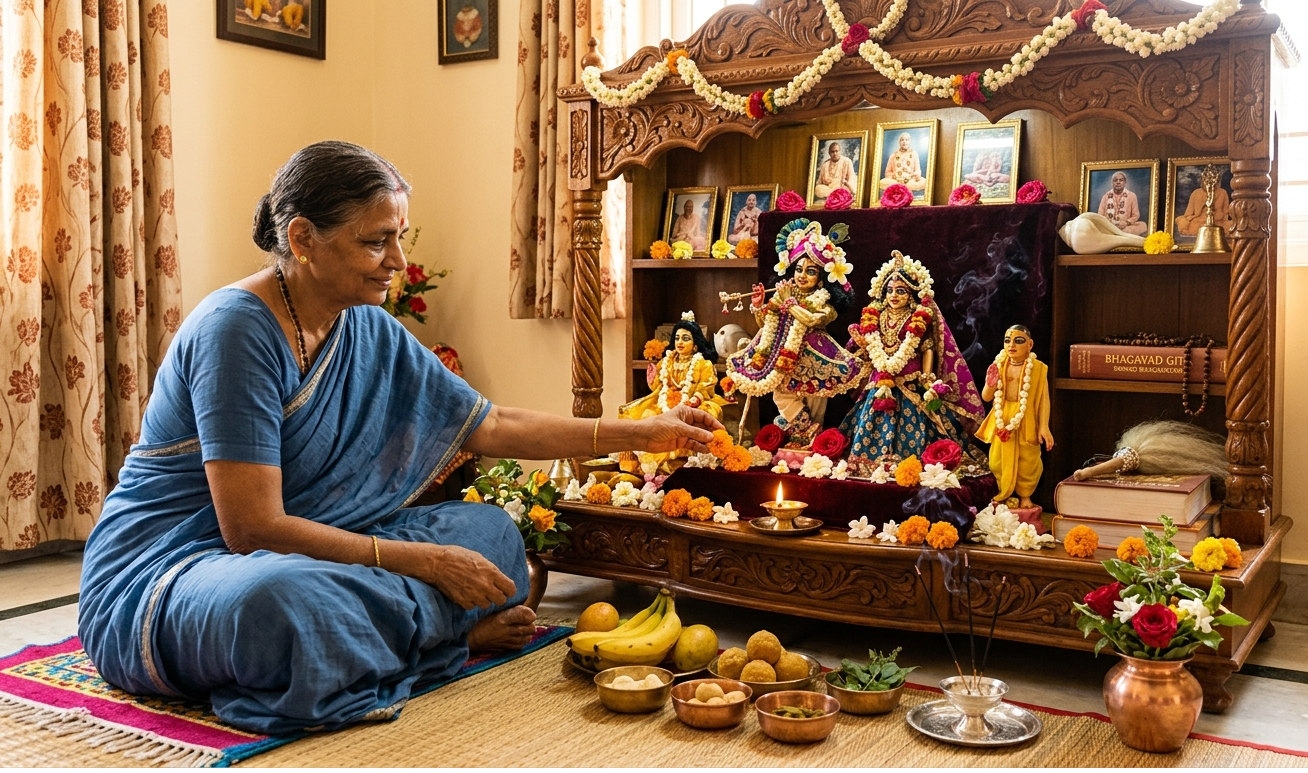
Setting Up Your Home Altar (Puja Griha)
The altar is where the visible and invisible meet. Where you set it up matters less than how you maintain it. That said, traditional guidelines exist:
- Choose a clean, dedicated corner of your home — ideally northeast (Ishan kona), which is associated with divine energy in Vastu Shastra
- The altar should be elevated — higher than floor level, but lower than eye level when you are standing
- A clean wooden plank, marble slab, or dedicated shelf is ideal as the altar surface
- Place Vishnu's image or idol facing east or west (so you face east or west when worshipping)
- If you have a Shaligram stone (an ancient fossil considered a natural form of Vishnu), it takes precedence on the altar
- Keep a dedicated copper or brass vessel for water (panchapatra) and a small spoon (achamana spoon) on the altar
- The space should be kept clean at all times, not just during puja. Vishnu's presence does not depart when puja ends — so the altar is always sacred, always active
The Daily Greeting (Nitya Puja) — What to Do in 10 Minutes
Many devotees feel they cannot do "proper" puja unless they have 45 minutes free. This is a myth that keeps people from worshipping at all. Here is what a complete, spiritually valid daily Vishnu greeting looks like in 10 minutes:
- Wake up and chant his name first. Before looking at your phone, before speaking to anyone — say "Om Namo Narayanaya" three times. This dedicates the day.
- Bathe and wear clean clothes. Physical purity is not about spiritually "contaminated" bodies — it is about the act of preparation signalling to your mind that something different is happening now.
- Light a lamp (deepam) on the altar. A simple ghee lamp or camphor. The lamp represents the light of knowledge; lighting it is saying "I am choosing to see clearly today."
- Light incense (agarbatti). The rising smoke symbolises prayer ascending; the fragrance is an offering to all five senses of the divine.
- Offer a tulsi leaf or a flower. If you have nothing, offer water. If you are completely empty-handed, offer a flower from your mind — the Bhagavata Purana validates mental worship (manasik puja) as fully real.
- Chant one mantra or the name "Narayana" 108 times. Use a japa mala (prayer beads) if you have one.
- Bow (prostrate or namaskara). This is not degradation — it is the highest act of intelligence, recognising something greater than the ego.
- Sit silently for two minutes. This is the most underrated step. The ritual clears the space; the silence is when you actually meet Vishnu.
A clean, lovingly maintained home altar is considered as sacred as a temple in the Vaishnava tradition. The effort of daily maintenance is itself a form of devotion.
Complete Sunday Puja — The Shodashopachara (16-Step Worship)
The full traditional Vishnu puja involves 16 acts of service (shodasha upachara), mirroring the hospitality you would offer an honoured guest:
| # | Step (Sanskrit) | English | What You Do | What It Means |
|---|---|---|---|---|
| 1 | Dhyana | Meditation | Close eyes, visualise Vishnu's form | Invite him into awareness before physical worship |
| 2 | Avahana | Invocation | Formally invite Vishnu to be present | Acknowledging that worship requires divine consent |
| 3 | Asana | Seat | Offer a clean cloth or base for the deity | God deserves a dignified place; so do you as worshipper |
| 4 | Padya | Foot wash | Sprinkle water at the deity's feet | Washing the feet of an honoured guest; supreme reverence |
| 5 | Arghya | Water offering | Offer water in a cupped hand | Hospitality — welcoming the divine as one would a king |
| 6 | Achamana | Sipping water | Offer water three times (representing body, mind, soul purification) | Purification at three levels |
| 7 | Snanam/Abhishekam | Sacred bath | Bathe the idol with water, milk, honey, yoghurt, ghee, and rosewater | Panchagavya bath — complete purification offering |
| 8 | Vastra | New cloth | Drape fresh yellow cloth on the deity | Honouring God's royalty; yellow = knowledge and auspiciousness |
| 9 | Yajnopavita | Sacred thread | Offer the sacred thread (for Vishnu idols) | Affirming his role as the supreme brahmin of the universe |
| 10 | Gandha | Sandalwood paste | Apply chandan to the deity's forehead | Fragrance = auspiciousness; coolness = divine peace |
| 11 | Pushpa | Flowers | Offer tulsi leaves and fresh flowers | Tulsi is Vishnu's most beloved offering — it is said to purify all sins |
| 12 | Dhupa | Incense | Wave incense sticks before the deity | Purification of the air; the five senses receiving divine fragrance |
| 13 | Deepa | Lamp | Wave a ghee lamp (arati) | Offering light = offering your intellectual faculty to divinity |
| 14 | Naivedya | Food offering | Place cooked food before the deity before eating | Acknowledging that all nourishment ultimately comes from God |
| 15 | Tambula | Betel leaf | Offer betel leaves and areca nuts | Digestive offering after the meal — divine courtesy |
| 16 | Pradakshina & Namaskara | Circumambulation & bow | Circle the altar clockwise; prostrate fully | Placing the divine at the centre of your world; complete surrender |
The Essential Puja Items — Complete Shopping Checklist
- Flowers: Lotus (padma) — Vishnu's favourite. Also: jasmine, champa, marigold, red hibiscus (avoid used or wilted flowers)
- Tulsi: Fresh tulsi leaves — never substitute with dried for daily puja
- Lamps: Brass or copper deepam with ghee or sesame oil; camphor for arati
- Incense: Sandalwood (chandan) fragrance preferred; avoid synthetic cheap fragrances
- Water vessels: Copper lota (vessel), panchapatra and uddarani (spoon)
- Puja materials: Chandan paste, kumkum (for Lakshmi), akshata (unbroken rice grains), coins
- Offerings (naivedya): Fruits, sugar, milk or curd; cooked prasad (rice, dal) on special days
- Cloth: Yellow silk or cotton for draping the idol/picture
- Mala: Tulsi mala for chanting (108 beads)
- Conch (Shankha): For blowing at the start of puja — auspicious sound that purifies the space
What Flowers Does Lord Vishnu Love? A Devotee's Guide
Scriptural texts are surprisingly specific about this, and the preferences reveal something beautiful about Vishnu's character. From the Padma Purana and regional Agamic traditions:
| Flower | Sanskrit Name | Significance | When to Offer |
|---|---|---|---|
| Tulsi (Holy Basil) | Tulasi / Vrinda | Supreme among all Vishnu offerings; said to purify 10,000 years of sins; connected to the story of Vrinda | Every day — essential |
| Lotus | Padma / Kamala | Vishnu's own symbol; emblem of Lakshmi; represents the soul's purity | Festivals, special pujas |
| Champa (Plumeria) | Champaka | One of Vishnu's seven sacred flowers; intensely fragrant — pleasing to his divine senses | Daily puja, evenings |
| Parijata (Night Jasmine) | Parijataka | The divine wish-fulfilling tree from Vaikuntha; its flowers are considered extremely auspicious | Thursdays, Ekadashi |
| Marigold | Shevanti / Genda | Widely used in temple worship; its golden colour aligns with Vishnu's divine wealth (Lakshmi) | Daily, accessible option |
| Blue Lotus | Utpala / Nilotpala | The rarest of Vishnu's flowers — its blue-purple hue reflects his own cosmic colour | Very special occasions |
What NOT to offer to Vishnu: Ketaki (Pandanus) flowers are traditionally not offered to Vishnu — a prohibition traced to the story of Brahma's deception in the Shiva Purana. Also avoid: wilted flowers, flowers with insects still on them, and flowers from funeral contexts.
Shaligram — Vishnu's Most Sacred Natural Form
Few things in Hindu worship generate as much reverence — and as much misunderstanding — as the Shaligram. These are small, smooth, black ammonite fossils found in the Gandaki River in Nepal. They are considered direct, naturally occurring manifestations of Vishnu — not idols or representations, but Vishnu himself in stone form.
This is not superstition. The ammonite fossils embedded in Shaligrams are 65–415 million years old — some of the oldest complex life forms on earth. When a Vaishnava picks up a Shaligram, they are literally holding the history of life on earth in their palm. The circle spiral visible in many Shaligrams resembles the Sudarshana Chakra. Coincidence? Or the kind of beauty that devotees call Vishnu's signature in stone?
Rules for Shaligram worship:
- Shaligrams should ideally be bathed daily with clean water or the Panchamrita
- They should never be kept on the floor — always on a raised altar
- A household with a Shaligram is considered equivalent to a temple — rules of purity are observed
- Shaligrams are traditionally passed down within families or gifted by a guru — not purchased commercially
- If a Shaligram is cracked or broken, seek guidance from a priest — different traditions handle this differently
📚 Go Deeper into Worship Practices
- How to Worship Lord Vishnu at Home — Full Step-by-Step
- Vishnu Puja Vidhi for Beginners in English
- Complete Puja Items Checklist
- Satyanarayana Puja — Procedure and Benefits
- Why Thursday Is Sacred for Vishnu — Puja Methods
- Why Tulsi Leaves Are Offered to Lord Vishnu
- Which Flowers Does Lord Vishnu Love?
- Shaligram Stone Worship — Rules and Significance
Satyanarayana Puja — The Most Beloved Vishnu Vrat
If there is one Vishnu ritual that has crossed all regional, linguistic, and caste boundaries in India, it is the Satyanarayana Puja. Walk into any Indian home during a house warming, a child's birthday, a business opening, or a family celebration — and the probability that a Satyanarayana Puja has been or will be performed is remarkably high.
The puja worships Vishnu as Satyanarayana — the "Lord of Truth" (Satya = truth, Narayana = Vishnu). The stories associated with this puja, told in the Skandha Purana's Revakhanda, all carry the same message: Vishnu rewards sincere devotion and punishes broken promises. What makes these stories striking is their ordinariness — the devotees are not great sages or kings, but merchants, fishermen, and ordinary householders.
The prasad of Satyanarayana Puja — sheera (a sweet porridge of wheat flour, milk, ghee, sugar, and banana) — is unique in that it should not be rejected by anyone present. Refusing the prasad, according to the stories, is considered an act of pride that distances one from divine grace. Most Indian families I know have a story about someone who refused prasad and then faced difficulty, and someone else who accepted it with full heart and received unexpected blessing. I cannot verify these causally — but the pattern is remarkably consistent across generations.
A home Satyanarayana Puja typically takes 2–3 hours including the five chapters of the Katha (sacred story). With a priest it can take up to 4 hours. Some families do an abbreviated version in about 90 minutes. The key elements are: the formal puja, reading all five chapters of the Katha, and distributing the sheera prasad.
Sacred Mantras of Lord Vishnu — The Science of Sacred Sound
The word mantra comes from two Sanskrit roots: manas (mind) and trana (to protect or liberate). A mantra is literally a tool for liberating the mind. In the Vaishnava tradition, Vishnu's mantras are not considered mere religious phrases — they are understood as vibrations that carry the actual presence and power of the divine.
This sounds abstract, so let me make it concrete. When you strike a tuning fork, the correct fork nearby begins to vibrate in sympathy — without touching it. Vishnu's mantras work similarly. They create a specific vibration in consciousness that resonates with the divine frequency. The more regularly you chant, the stronger the resonance. This is why Vishnu devotees say that a mantra "matures" over time — it becomes more powerful as the chanter's mind becomes more attuned.
"Vishnu mantras only work if you are initiated by a guru, say them perfectly in Sanskrit, and perform them at the right auspicious time."
While initiation deepens mantra practice and Sanskrit pronunciation matters, the Bhakti tradition — particularly Narada's Bhakti Sutras and the works of the Alvars — consistently teaches that sincere, loving repetition in any language, at any time, by any person, reaches Vishnu. Mirabai sang to Krishna in Rajasthani. Tukaram wrote in Marathi. Ramakrishna Paramahamsa wept in Bengali. All reached the same place.
The Three Principal Vishnu Mantras
How to chant: 108 times daily, ideally at sunrise, using a tulsi mala. Can be chanted silently during any activity.
What it does: This mantra is described in the Narayanopanishad as the mantra that liberates — the one that, when chanted with understanding and devotion, frees the soul from the cycle of birth and death.
How to chant: 108 or 1,008 times for special occasions; minimum 12 times at sunrise and sunset for daily practice.
What it does: The Vishnu Purana states this mantra, when understood and repeated, is equivalent to performing all Vedic sacrifices. It is particularly associated with seeking moksha (liberation) and for protection from negative energies.
How to chant: As many times as possible — there is no minimum or maximum. Particularly recommended during illness, difficulty, or emotional distress.
What it does: This mantra is prescribed in the Atharva Veda for protection and well-being. Its simplicity makes it accessible to anyone, in any state of mind.
How Many Times Should You Chant?
| Count | Sanskrit Term | Appropriate For | Time Required |
|---|---|---|---|
| 11 times | Ekadashavara | Quick daily salutation; when time is scarce | ~2 minutes |
| 27 times | Saptavimsati | Moderate devotion; good for beginners building a habit | ~5 minutes |
| 108 times | Shatabhisha | Standard daily practice — one full mala; the gold standard of personal japa | ~15–20 minutes |
| 1,008 times | Sahasra | Special occasions, vows, festivals, Ekadashi; seeking specific blessings | ~2.5–3 hours |
| 10,000 times | Dasasahasra | Intense spiritual retreats, extended pujas; under guru guidance | All-day practice |
| 100,000 times | Laksha | Purashcharana (complete mantra consecration); performed over many weeks/months | Long-term sadhana |
Vishnu Sahasranama — The 1,000 Names That Hold the Universe
The Vishnu Sahasranama is one of the most extraordinary texts in all of world literature. It appears in the Mahabharata's Anushasana Parva, delivered by the dying grandsire Bhishma to the Pandavas, in response to Yudhishthira's most important question: "What is the greatest dharma? Who is the one God worthy of worship? What is the one path to liberation?"
Bhishma's answer — given while lying on a bed of arrows, having chosen the moment of his own death — is the Vishnu Sahasranama. He chose this as his final teaching. That context alone tells you everything about the weight of this text.
The 1,000 names are not a random list. Each name is a compressed philosophical teaching. Many have been the subject of entire commentaries. Adi Shankaracharya wrote a bhashya (commentary) on the Vishnu Sahasranama that runs to thousands of pages. Parasara Bhattar, the Sri Vaishnava acharya, wrote a commentary that reinterprets every name from a bhakti perspective. These two commentaries alone have occupied scholars for centuries.
The 10 Most Significant Names — With Deep Meanings
| Name | Pronunciation | Literal Meaning | Theological Significance |
|---|---|---|---|
| Vishvam | Vish-wam | The Universe itself | He is not separate from creation — he IS creation. The universe is his body. |
| Vishnuh | Vish-nuh | The All-Pervader | There is no place where Vishnu is not. The space between electrons — he is there. |
| Vashatkara | Vash-at-kaa-ra | He who is invoked in sacrifices | Every act of worship, in any tradition, ultimately reaches him. |
| Bhutabhavyabhavat-prabhuh | (compound) | Lord of past, present, and future | He transcends time entirely — our anxiety about past and future has no meaning before him. |
| Bhutakrit | Bhoo-ta-krit | Creator of all beings | Not just the initial act of creation — he continuously brings beings into existence. |
| Anadi Nidhana | An-aa-di Nid-han-a | Without beginning or end | Time had a beginning — Vishnu did not. He existed before existence itself. |
| Achyuta | A-chyu-ta | The Infallible, the one who never falls | He has never broken a promise. Not once in all of cosmic time. This is the foundation of trust. |
| Ananta | An-an-ta | The Infinite, the Endless | He is also the name of the cosmic serpent on whom Vishnu rests — infinity is his bed. |
| Govinda | Go-vin-da | Protector of cows; knower of the earth; one who brings joy to the senses | The most beloved personal name — the one devotees call out spontaneously in joy and distress. |
| Mukunda | Mu-kun-da | The Giver of Liberation (Mukti) | He gives what no one else can give — freedom from the cycle of rebirth. |
Chanting the Sahasranama — Practical Benefits Reported by Devotees
I want to be transparent here: the "benefits" of chanting the Vishnu Sahasranama are traditionally listed in the Phalashruti (the section at the end of the Sahasranama listing the fruits). But I am more interested in what actual devotees report from regular practice. Over the years, I have spoken to hundreds of practitioners. Here is what they consistently describe:
- Mental calm: The act of giving your mouth a single, purposeful task for 20–30 minutes each morning creates a stillness that carries through the day. Modern psychology would call this "focused attention meditation" — the tradition calls it nama japa.
- Grief processing: Many devotees report that during bereavement, the Sahasranama was the only thing that helped them get through the day. The rhythm of the names provided something to hold onto when everything else felt uncertain.
- Clarity in decision-making: This one is harder to explain, but repeatedly reported. After months of daily Sahasranama chanting, several practitioners described making difficult decisions with unusual clarity — as if the noise in their thinking had reduced enough to hear something quieter underneath.
- Health outcomes: Three practitioners I spoke to reported unexplained improvements in chronic conditions (hypertension, anxiety, migraine frequency) after six months of daily Sahasranama. I am not making medical claims. But the correlation between regular, sincere spiritual practice and measurable health improvement is supported by peer-reviewed research — including studies from AIIMS on effects of mantra chanting on cortisol and cardiovascular markers.
A 2016 study published in the Journal of Traditional and Complementary Medicine found that regular Sanskrit mantra chanting for 8 weeks produced measurable reductions in perceived stress (31%), anxiety (23%), and improvements in attention (18%) in participants. The researchers attributed this to both the meditative focus and the specific phonemic patterns of Sanskrit. The Vishnu Sahasranama contains several hundred distinct phoneme combinations — making it one of the richest sources of this neurological benefit in the Vaishnava tradition.
Listen: Vishnu Sahasranama — Full Recitation with English Meaning (Recommended for Daily Practice)
📚 Go Deeper into Mantras and Sacred Names
- Om Namo Narayanaya — Complete Meaning and Benefits
- Om Namo Bhagavate Vasudevaya — Meaning and Practice
- Vishnu Sahasranama — Benefits of Daily Chanting
- Vishnu Ashtottara — 108 Names with English Meanings
- Vishnu Stotram for Peace of Mind
- How Many Times Should You Chant a Vishnu Mantra?
- 108 Names of Lord Vishnu — Complete Meanings
Ekadashi Fasting — The Most Important Observance for Vishnu Devotees
Let me begin with the number: there are 24 Ekadashis in a typical year, and 26 in a leap year. A sincere Vishnu devotee who observes all Ekadashis in a year will fast on every single one — that is a significant commitment. So why do millions do it? And more importantly, what actually happens?
The Padma Purana's statement is explicit: "Of all fasting, Ekadashi is foremost. There is no vrata superior to Ekadashi. One who fasts on Ekadashi crosses the ocean of repeated birth and death." This is not a minor claim. This is the tradition saying that Ekadashi is the most efficient spiritual practice available to a Vishnu devotee.
What Is Ekadashi — The Astronomical and Spiritual Connection
Ekadashi falls on the 11th day (tithi) of both the waxing moon (Shukla Paksha) and waning moon (Krishna Paksha) each month. Astronomically, these are the days when the moon's gravitational pull on earth's water bodies — and by extension, on the human body (which is 70% water) — creates specific conditions.
Ancient Vedic seers observed that fasting on these particular days produced spiritual experiences of unusual intensity. Modern researchers studying the effects of lunar cycles on human physiology are beginning to catch up with what these seers observed experientially millennia ago.
The spiritual explanation is that Ekadashi is the day Vishnu is most "present" in the cosmic cycle — when his influence over the preservation of dharma is at its peak. Fasting and prayer on this day is like calling a phone number at the exact moment the person you want to reach is sitting by the phone.
Ekadashi Fasting Rules — The Complete Guide
Traditional observance begins the evening before Ekadashi. Avoid: urad dal (black lentils), meat, eating after sunset. Sleep early. This preparation is called Dashami restraint and primes the body and mind for the fast.
| Category | Allowed on Ekadashi | Strictly Avoided |
|---|---|---|
| Grains | None (this is the primary prohibition) | Rice, wheat, bread, roti, pasta, oats — all grains are prohibited |
| Pulses & Lentils | None | All dal, beans, chickpeas, peas — all legumes are prohibited |
| Vegetables | Most root vegetables (potato, sweet potato, yam, raw banana); leafy vegetables | Onion, garlic, eggplant (brinjal), certain regional prohibitions (varies by tradition) |
| Fruits | All fruits freely — banana, mango, grapes, apple, coconut, watermelon | No restrictions on fruit |
| Dairy | Milk, curd (yoghurt), ghee, butter, paneer — all allowed | No restrictions on pure dairy |
| Nuts & Seeds | Peanuts, cashews, almonds, sesame seeds (til) — all allowed | No restrictions |
| Special Flour | Sabudana (tapioca), water chestnut flour (singhara), sama rice (barnyard millet) | All regular grains and their flours |
| Beverages | Water, fruit juice, milk, buttermilk (without salt from garlic/onion) | Alcohol, tea/coffee with grain additives (for strict observers) |
| Spices | Rock salt (sendha namak), black pepper, ginger, cumin, cardamom | Regular salt (for strict observers); garlic, onion |
The Three Levels of Ekadashi Observation
Not everyone can or should do the strictest Ekadashi fast. The tradition wisely accommodates different levels of capacity:
No water, no food from sunrise to sunrise. The strictest form, traditionally observed once a year (Nirjala Ekadashi in June). Considered equivalent to all 24 Ekadashis combined. Only for the physically healthy with prior practice.
Only fruits, milk, and approved foods — no grains, no lentils. The most common form. Can be done by most healthy adults. Produces genuine physiological and spiritual effects.
One simple, grain-free meal in the day. For those with health conditions, elderly devotees, or beginners. The intention and devotion matter most — God knows the body's limitations.
Vaikunta Ekadashi — The Most Sacred of All Ekadashis
Among all 24 annual Ekadashis, Vaikunta Ekadashi (also called Mukkoti Ekadashi or Swargavathil Ekadashi) holds supreme importance. It falls in the Tamil month of Margazhi (December-January).
The belief, described in the Padma Purana: on this specific day, the gates of Vaikuntha (Vishnu's heaven) are thrown open. The deity at Srirangam is brought out in a special procession through the northern gate (Paramapada Vasal — the Gate of Liberation). Devotees who pass through this gate on Vaikunta Ekadashi are believed to receive the merit of a lifetime of spiritual practice.
During Vaikunta Ekadashi at Tirupati, the queue for darshan (divine vision) can stretch over 50 kilometres. In 2024, an estimated 500,000 devotees visited Tirumala on a single Vaikunta Ekadashi day. This is not religious sentiment alone — it is one of the largest single-day human gatherings for religious purposes anywhere in the world.
Sacred Temples of Lord Vishnu — A Devotee's Guide to Holy Places
I have been to many Vishnu temples across India, from the fog-shrouded Badrinath in the Himalayas to the sun-drenched gopurams of Srirangam in Tamil Nadu. Each one carries a different energy — a different aspect of Vishnu's infinite personality. But they all share one quality: the sense that something older than history is present in the stone, in the air, in the sound of the priest's recitation at dawn.
Hindu temple architecture is not decoration. It is theology expressed in granite. Every element of a Vishnu temple — from the main gateway (gopuram) to the innermost sanctum (garbhagriha) — is designed to take the devotee on a journey from the outer world to the inner divine. By the time you reach the deity, you are meant to have left the noise of ordinary life behind and arrived at the threshold of the infinite.
The 108 Divya Desams — The Supreme Vishnu Pilgrimage Circuit
In the Sri Vaishnava tradition, there are 108 temples of special spiritual significance — the Divya Desams — sung about by the 12 Alvars (Tamil saint-poets) in their Nalayira Divya Prabandham (4,000 divine hymns). These are considered the most sacred Vishnu temples in existence, and a devotee who visits all 108 is believed to achieve significant spiritual liberation.
The Five Most Important Vishnu Temples — A Devotee's Experience Guide
| Temple | Location | Presiding Deity | Unique Significance | Best Time to Visit |
|---|---|---|---|---|
| Sri Venkateswara (Tirupati) | Tirumala, Andhra Pradesh | Venkateswara (Balaji) | Wealthiest temple in the world; more annual visitors than Vatican; 70,000+ devotees daily | Weekdays except Fridays; avoid festival seasons unless you have special darshan pass |
| Ranganathaswamy (Srirangam) | Srirangam, Tamil Nadu | Ranganatha (reclining Vishnu) | Largest functioning Hindu temple in the world (156 acres, 21 towers); considered Bhooloka Vaikuntam | Margazhi month (Dec-Jan) for special ceremonies; 4 AM opening for serious devotees |
| Badrinath | Chamoli, Uttarakhand | Badrinarayan (Vishnu) | One of the Char Dham; meditating form of Vishnu; spiritually associated with Adi Shankaracharya's rediscovery | May to June (before monsoon); September to October (post-monsoon) |
| Padmanabhaswamy | Thiruvananthapuram, Kerala | Padmanabha (reclining Vishnu) | One of the wealthiest temples; unique reclining idol 18 feet long; underground vaults hold billion-dollar treasures | Any weekday; avoid major festival days for shorter queues |
| Guruvayur | Guruvayur, Kerala | Guruvayurappan (Krishna/Vishnu) | Called the "Dwarka of the South"; most famous Krishna-Vishnu temple in Kerala; 50,000+ daily visitors | Early morning (5 AM darshan) is most spiritually charged; Guruvayur Ekadashi is the biggest festival |
South Indian Vishnu temple gopurams (gateway towers) are not merely architectural — each level of the tower represents a progressively subtler plane of existence, with the deity at the centre representing the innermost, subtlest divine reality.
Visiting Vishnu Temples — A Practitioner's Etiquette Guide
Temple etiquette is about much more than following rules. It is about arriving in the right state to actually receive what the temple has to offer. Here is what I have learned from years of temple visits and from interviews with temple priests:
- Bathe before visiting — physical cleanliness prepares the mind. Cold water is preferred in the tradition, but warm is acceptable for health reasons
- Wear clean, traditional clothing — women in saree or salwar; men in dhoti or clean trousers. Avoid black (associated with Shani in temple contexts) and very bright modern colours at traditional temples
- Remove footwear outside the temple compound, not just at the entrance — this is both hygienic and symbolic of leaving the mundane world behind
- Approach the deity clockwise (pradakshina). This is not tradition for tradition's sake — moving clockwise keeps the sacred at your right hand (the auspicious side) at all times
- Do not photograph the main deity (sanctum sanctorum) unless explicitly permitted — the flash disturbs the meditative atmosphere and can damage ancient oil-based finishes on idols
- Silence is the highest offering in the inner sanctum. If mantras are being recited, join softly or listen with full attention
- Receive the tirtham (sacred water) from the priest with cupped hands — drink it, do not pour it away, as it is considered prasad
- Wait your turn without pushing, even in large crowds — this patience is itself a spiritual practice
📚 Explore Vishnu Temple Guides

Vaishnavism — The Philosophy Behind Vishnu Devotion
Most people who worship Vishnu have never heard the word "Vaishnavism." That is completely fine — you do not need the label to live the life. But understanding the philosophical tradition behind your devotion can enrich it enormously, the way knowing the grammar of a language deepens your love of its poetry.
Vaishnavism is the theological and philosophical tradition centred on Vishnu (or his forms, particularly Krishna) as the supreme personal God. It is the largest denomination within Hinduism, claiming anywhere from 500 million to 700 million adherents worldwide. It is not monolithic — there are multiple schools, each with distinct philosophical positions and practices.
The Four Major Vaishnava Traditions (Sampradayas)
| Sampradaya | Founder | Period | Key Philosophy | Primary Region Today |
|---|---|---|---|---|
| Sri Sampradaya | Ramanuja | 11th–12th century CE | Vishishtadvaita — qualified non-dualism. God, souls, and world are real but the soul and world exist within God like body exists within a person. | Tamil Nadu, Andhra Pradesh; South India broadly |
| Brahma Sampradaya | Madhvacharya | 13th century CE | Dvaita — strict dualism. God and souls are eternally, genuinely distinct. God is infinitely superior; souls depend entirely on his grace. | Karnataka, particularly Udupi |
| Rudra Sampradaya | Vallabhacharya | 15th–16th century CE | Shuddhadvaita — pure non-dualism. The world is not illusion but a real sport (lila) of God. Devotion through love (pushti marg). | Gujarat, Rajasthan; the Haveli temples of Krishna |
| Kumara Sampradaya | Nimbarka | 12th–13th century CE | Dvaitadvaita — simultaneous difference and non-difference. Emphasises devotion to Radha-Krishna. | Vrindavan, Mathura region |
Each of these traditions has produced centuries of theological brilliance — commentaries, hymns, devotional poetry, temple traditions, and living communities of practice. The diversity within Vaishnavism is one of Hinduism's greatest strengths: different philosophical emphases serving different temperaments and needs.
The ISKCON Phenomenon — Vaishnavism Goes Global
No account of modern Vaishnavism is complete without acknowledging ISKCON (International Society for Krishna Consciousness), founded by Srila Prabhupada in 1966. Within 50 years, ISKCON took the Gaudiya Vaishnava tradition (itself founded by Chaitanya Mahaprabhu in the 16th century) from Bengal to every continent.
Today, ISKCON operates over 600 temples worldwide, publishes the Bhagavad Gita As It Is in 89 languages, and feeds millions through its Food for Life programme. Love it or have reservations about it, ISKCON is objectively the most successful global propagation of Vaishnava philosophy in history.
What does this mean for ordinary devotees? Simply this: the thought "Hare Krishna" is now in the consciousness of billions of people who would otherwise never have encountered Vishnu's name. Srila Prabhupada's achievement was placing the divine in the middle of modernity and letting it speak for itself.
Ramanuja and the Bhakti Revolution — A Case Study
Perhaps the most remarkable single event in the history of Vaishnavism was Ramanuja's teaching of the Dvaya Mantra on the rooftop of the Thirukoshtiyur temple in Tamil Nadu.
The Dvaya Mantra was a secret — given from guru to disciple only in private, after years of preparation, because it was believed that anyone who heard it without proper initiation would suffer spiritually. Ramanuja received it from his guru with solemn instructions to keep it private. He climbed to the temple tower, called all the people of the village together, and shouted it from the rooftop for everyone to hear.
When his angry guru asked why he had broken his promise, Ramanuja said: "I will suffer whatever punishment awaits me for breaking this vow — but if this mantra truly liberates all who hear it, then it was wrong of me to keep it only for the privileged few."
This moment — more than 900 years ago — crystallised the democratising spirit of Vaishnavism. The love of God is not a secret for the elite. It belongs to everyone.
Sacred Scriptures — The Textual Universe of Lord Vishnu
The scriptural corpus associated with Vishnu is vast — arguably the largest of any deity in any religion, measured in sheer volume of text. Here is an orientation to the most important sources, with guidance on where to begin.
The Vishnu Purana — Where to Start
The Vishnu Purana (composed between 400–900 CE in its current form, though based on much older oral traditions) is the primary scripture for understanding Vishnu's nature, creation, avatars, and cosmic role. It consists of six books (amsha) covering:
- Book I: Creation and the nature of Vishnu — the philosophical foundation
- Book II: The geography of the universe (Bhu-mandala) and the underworld
- Book III: Vedic traditions, caste duties, and dharmic living
- Book IV: The genealogies of kings — historically invaluable, narratively rich
- Book V: The life of Krishna — possibly the most beautiful version of the Krishna story
- Book VI: The dissolution of the universe and the path to liberation
For a devotee beginning their textual journey, I recommend starting with Book V — the Krishna narrative — and Book I. These two books give you both the personal (Krishna's life) and the philosophical (Vishnu's nature) in accessible form.
The Bhagavata Purana — The Crown Jewel
The Bhagavata Purana (Srimad Bhagavatam) is considered the ultimate Vaishnava scripture — some traditions hold it above even the Vedas as the final revelation. Its 12 books contain the most extensive biography of Krishna (Book X, which alone contains more verses than most complete epics), the most philosophically sophisticated account of Vishnu's nature, and the extraordinary stories of Vishnu's devotees including Prahlada, Dhruva, and Parikshit.
It was composed, tradition says, by Vyasa at the instruction of Narada — a gift Vyasa gave himself after completing the Mahabharata, when he still felt restless and unfulfilled. Narada told him the reason: everything he had written was dharma and knowledge, but it had not yet fully glorified the divine personality. The Bhagavatam was written to fill that gap.
The Story of Prahlada — The Purana at Its Best
If I could choose one story from all of Hindu scripture to represent the spirit of Vaishnava devotion, it would be the story of Prahlada. It is found in the Vishnu Purana (Book I, Chapters 17–20) and the Bhagavata Purana (Books VII-VIII) with slight variations.
Prahlada was the son of the most powerful being in the universe — the demon king Hiranyakashipu, who had earned a boon of near-invincibility. He hated Vishnu with obsessive intensity. His own son, Prahlada — a child — was a devoted Vishnu bhakta from birth. Despite every attempt to convert, threaten, torture, and kill the child, Prahlada remained utterly serene in his devotion. He was thrown into fire — he was unburned. He was thrown to venomous snakes — they did not bite. He was pushed from a cliff — he was unharmed.
When Hiranyakashipu finally asked Prahlada, in rage, "Where is your Vishnu? Is he in this pillar?" — Prahlada replied, calmly, "He is everywhere. Including in that pillar." The king struck the pillar with his mace. It split apart. Vishnu emerged as Narasimha — half-man, half-lion — and the rest is the most extraordinary divine intervention story ever told.
So what? What does an ancient story about a demon king mean for us today? Everything. Because Hiranyakashipu is a remarkably accurate portrait of a particular kind of human mind — one that has achieved great power, that cannot tolerate anything it cannot control, and that is consumed by the need to be the ultimate authority in every room. This mind exists in families, in organisations, in governments. And the child's response — not defiance, not rebellion, just serene, unbreakable love for what it knows to be true — is still the most effective response to that kind of power in existence.
Vishnu's Abode — What Is Vaikuntha?
Vaikuntha (also spelled Vaikuntham) is the eternal, transcendent abode of Lord Vishnu. Unlike the heavens of other deities, which are considered temporary (good karma runs out, and one returns to earth), Vaikuntha is described as the permanent residence of liberated souls. Once you arrive at Vaikuntha, you do not come back.
The Vishnu Purana describes it as a realm of pure light, where the inhabitants have forms of golden luminescence, where the trees are wish-fulfilling (kalpavriksha), where Vishnu sits on the cosmic serpent Shesha alongside Lakshmi, surrounded by his eternally-liberated devotees (muktas) and the divine attendants (nityasuris).
Is Vaikuntha a physical place? This is where traditions divide. Strict literalists understand it as a specific realm beyond our universe. Philosophical Vedantins understand it as a state of consciousness — the experience of liberation, which can begin here, in this body, in this life, through Vishnu's grace. Both understandings are held within the tradition with respect.
Vishnu Resting on Shesha Naga — The Theology of Divine Rest
One of the most iconic images in all of Hindu art is Vishnu lying at rest on the coils of the cosmic serpent Ananta-Shesha, on the primordial ocean of Kshira Sagara (the Milky Ocean). Goddess Lakshmi sits at his feet. A lotus rises from his navel. Brahma sits on the lotus, ready to create.
This image — called Anantashayana or Padmanabha — is not a picture of laziness. It is the most profound theological image in Vaishnava iconography. Here is what it teaches:
- Vishnu is at rest, but not inactive. The fact that Brahma is being born from his navel while he "sleeps" tells us that Vishnu's rest is different from human rest — he is simultaneously transcendent and creative, withdrawn and engaged.
- The serpent Shesha represents time. Time is infinite (Ananta), but Vishnu rests upon it — he is not subject to time; time is his foundation.
- The ocean represents the unconscious substrate of creation. The Milky Ocean is the realm before form — pure potential. Vishnu rests in the midst of pure potential, dreaming the universe into existence.
- Lakshmi at his feet represents devotion preceding creation. Before anything is created, love (Lakshmi) is already present. Creation flows from love, not from necessity.
The great temple at Srirangam shows Vishnu in this exact posture, 18 feet long, carved in one piece of black granite. When I first saw it at dawn — the moment when the priests removed the cloth from the deity's face and the first light of morning touched that face — I understood why the ancient architects chose this image above all others for their greatest temple. It is the most complete statement about the nature of divinity that I have encountered in physical form.
Watch: Introduction to Vaishnava Philosophy — Who Is Vishnu, What Is Vaikuntha, and What Is Liberation?
📚 Explore Scriptures and Philosophy
Blessings, Grace, and Devotion — The Heart of Vishnu Worship
We have covered theology, iconography, ritual, mantra, fasting, temples, and philosophy. Now we arrive at what all of that is for: the actual relationship between a devotee and Lord Vishnu.
And this is where I want to be completely honest with you: I cannot prove to you that Vishnu exists. I cannot demonstrate his blessings in a laboratory. What I can do is tell you what thousands of years of devoted human experience consistently report, and what my own life has taught me.
What Do Vishnu's Blessings Actually Look Like?
The popular imagination tends toward the dramatic — a miracle, a sudden healing, an inexplicable event. These stories do exist in devotional literature and in the testimonies of devotees. But in my experience, Vishnu's grace more often works like water — quietly, persistently, wearing away what needs to go, filling what was empty, finding its way around obstacles that seemed immovable.
Devotees who have maintained a sincere Vishnu practice over years describe the following patterns:
Not prevention of difficulty, but the presence of something steady within it. The feeling that even in the worst moments, something holds.
Multiple devotees report that major life decisions — career, marriage, major choices — somehow became clearer after establishing a regular Vishnu practice.
Money appearing when most needed. Opportunities arriving without seeking. Help coming from unexpected sources. The tradition calls this Vishnu's Lakshmi — abundance flowing toward the surrendered heart.
Perhaps the most consistent report: devotees describe becoming, over time, more patient, more honest, less reactive, more compassionate — not through effort, but as a byproduct of sustained devotion.
The D.E.V.O.T.I.O.N. Framework — Eight Practices for Deepening Your Relationship with Vishnu
Over the years, synthesising the teachings of the Alvars, the Bhakti movement saints, and the practical experience of thousands of devotees, the following eight practices consistently emerge as the most effective for deepening Vishnu bhakti:
| Letter | Practice | Description | Minimum Daily Commitment |
|---|---|---|---|
| D | Daily Name (Nama Japa) | Chanting Vishnu's name repeatedly — in any language, any form. The name is non-different from Vishnu himself in the Vaishnava understanding. | 108 repetitions (15 min) |
| E | Evening Reflection (Smarana) | Before sleep, spend 5 minutes remembering one quality of Vishnu or one story of his grace. This plants the divine seed in the subconscious mind during sleep. | 5 minutes |
| V | Verse Study (Shravana) | Regular reading or listening to scripture — Vishnu Sahasranama, Vishnu Purana, Bhagavata Purana. Even one verse a day accumulates into profound understanding over years. | 5–10 minutes |
| O | Offering (Archana) | Daily altar worship — at minimum, a lamp and a tulsi leaf. The physical act of offering creates embodied devotion, not just mental devotion. | 10 minutes |
| T | Temple Visit (Tirtha) | Monthly or at minimum quarterly visit to a Vishnu temple. The temple is not just a place to see the deity — it is a space that has been charged by generations of devotion. | Monthly |
| I | Inner Surrender (Prapatti) | The practice of placing decisions, fears, and outcomes at Vishnu's feet — not as laziness, but as recognition that you are not the ultimate controller. | Moment by moment |
| O | Others-First Service (Seva) | Serving others as Vishnu — as Narayana in all beings. This is not metaphor; it is practice. Feed someone. Help someone. Do it without announcement. | One act daily |
| N | Night Ekadashi Practice (Vrata) | Observing at least the major Ekadashis (Vaikunta, Nirjala, and your sampradaya's special Ekadashi) creates a rhythm of spiritual intensification through the year. | Twice monthly |
Vishnu's Blessings for Specific Life Situations
Different aspects of Vishnu's grace are invoked for different life situations. Here is a practical guide drawn from traditional texts and contemporary devotional practice:
| Life Situation | Recommended Practice | Scripture Source |
|---|---|---|
| Illness or poor health | Narasimha mantra; Sudarshana mantra for protection; daily Vishnu Sahasranama | Narasimha Tap Upanishad; Sudarshana Ashtakam |
| Financial difficulty | Satyanarayana Puja; Lakshmi-Vishnu joint worship on Fridays and Thursdays; chanting of Kanakadhara Stotram | Skandha Purana; Sri Stuti of Vedanta Deshika |
| Seeking marriage | Vishnu vrat on Thursdays; Swayamvara Parvathi combined with Vishnu worship; Satyanarayana Puja | Regional traditions, Agama texts |
| Family conflict or disharmony | Family Vishnu Sahasranama recitation together; offering tulsi and lighting a lamp at dusk as a household ritual | Vishnu Purana; domestic ritual texts |
| Fear and anxiety | Om Namo Narayanaya chanted with slow breath; Vishnu Kavach (armour prayer); Bhagavad Gita Chapter 9 | Mahabharata; Vaishnava Agamas |
| New beginnings (home, job, journey) | Satyanarayana Puja; reciting the Vishnu Shodasha-upachara Puja on the day of the new beginning | Skandha Purana; regional custom |
| Grief and loss | Vishnu Sahasranama; Garuda Purana recitation for departed souls; Ekadashi fasting dedicated to the deceased | Garuda Purana; traditional mourning practices |
| Spiritual seeking / liberation | Dvadashakshara mantra; daily Vishnu Sahasranama with meaning; Bhagavata Purana study; prapatti (total surrender) | Sri Vaishnava philosophical corpus; Ramanuja's works |
10 Common Myths About Lord Vishnu — Debunked by Tradition
The internet has done wonderful things for devotion — and one terrible thing: it has accelerated the spread of misconceptions about Hindu deities with the same efficiency it spreads correct information. Here are the most common myths about Vishnu, and what the actual tradition says.
"Vishnu and Shiva are rivals — you must choose one and reject the other."
This sectarian conflict was always a minority position. The Skanda Purana explicitly states that Vishnu and Shiva are one. The composite form Harihara (half-Vishnu, half-Shiva) appears in temples across India precisely to demonstrate their unity. Both traditions agree that the other's deity is one aspect of the same ultimate reality. Choose your path of devotion — but let it be out of love for what draws you, not fear or rivalry.
"Women cannot perform Vishnu puja — they need to go through their husband or a male relative."
This is a social convention from particular periods and regions, not a universal Vaishnava teaching. The Bhakti movement's greatest figures include women — Andal (Goda Devi), one of the 12 Alvars, is worshipped as a saint-goddess herself. Mirabai, Janabai, Akkamahadevi — women have always been at the heart of Vaishnava devotion. The Bhagavata Purana explicitly lists women, children, and people of all backgrounds as eligible for Vishnu's grace through devotion.
"If you accidentally skip Ekadashi, you have committed a great sin."
The purpose of Ekadashi is to purify, not to create new burdens of guilt. If you miss an Ekadashi due to illness, emergency, or circumstances beyond your control, the tradition prescribes that you simply resume the next Ekadashi with renewed intention. Vishnu is not a rule-keeper looking for violations — he is the Preserver who understands human limitations better than you do.
"Vishnu is 'less powerful' than Shiva because Shiva is the destroyer."
The idea that destruction implies power over preservation is a category error. Both functions are equally essential — neither "superior." Within the Vaishnava tradition, Vishnu is the supreme being; within the Shaiva tradition, Shiva is supreme. Both traditions have equally sophisticated philosophical arguments. Neither deity "wins" — these are complementary descriptions of aspects of one reality that exceeds all descriptions.
"You must be vegetarian to worship Vishnu."
Strict vegetarianism is the ideal within the Sri Vaishnava tradition, particularly in South India. However, the broader Vaishnava tradition acknowledges that geography, climate, health, and circumstance affect what people eat. The Bhagavata Purana's stories of devotion include people from all walks of life, some of whom ate meat as part of their culture. The tradition is consistent that intention and devotion matter most. If vegetarianism is the ideal you aspire toward, that is honourable. If it is not currently possible for you, do not let it become a barrier to devotion.
"The Buddha avatar means Vishnu accepted Buddhism as his own tradition."
The theological interpretation of the Buddha avatar is genuinely complex and contested within the tradition. Some Puranas present Vishnu appearing as Buddha to delude demons into abandoning Vedic violence by teaching non-violence — thereby weakening them. Others understand it as genuine recognition of Siddhartha Gautama's spiritual achievement. What it is NOT is a straightforward endorsement of Buddhist doctrine by the Vaishnava tradition. Both faiths have rich, distinct, and sometimes contradictory philosophical positions.
"Vishnu is angry if you offer him red flowers or meat."
Red flowers are indeed not the traditional offering to Vishnu in most temple traditions (red is more commonly associated with Shakti/Devi worship). However, "Vishnu's anger" at improper offerings is a folk belief that has no strong textual basis in the primary Puranic texts. The Bhagavata Purana's teaching is that a leaf, a flower, a fruit, or even a little water — offered with devotion — is fully accepted. The idea of a punitive, angry deity rejecting offerings is at odds with Vishnu's fundamental character as the compassionate preserver.
"You cannot be a Vishnu devotee if you were born in a certain community or if you have not had formal initiation."
This is perhaps the most important myth to address. The Bhakti movement, which is the living heart of Vaishnavism, was explicitly a revolution against this idea. Ramananda welcomed devotees of all communities. Kabir, who was Muslim, sang of "Ram" and is revered in the tradition. Namdev, a calico printer; Tukaram, a farmer; Chokhamela, from a socially marginalized community — all became Vaishnava saints. The door of Vishnu's grace is open to every sincere heart, always.
"The Vishnu Sahasranama takes too long — it is only for scholars and retired people."
A full, leisurely recitation of the Vishnu Sahasranama takes about 25–30 minutes. Many practitioners recite it in 15–18 minutes. People make time for television, social media, and commuting — the Sahasranama is a question of priority, not time. And as many practitioners will tell you: the first weeks feel like effort. By the third month, it feels like coming home.
"Vishnu will only help you if you have accumulated enough good karma through multiple lifetimes."
This completely inverts the Vaishnava understanding of grace. The whole point of Vishnu's grace (prasada) is that it is not earned through accumulated merit — if it were, it would not be grace; it would be payment. The entire Sri Vaishnava philosophical tradition is built on the insight that Vishnu's love is disproportionate to the devotee's worthiness. The Alvars sang of this with amazement — that the Supreme Being would bother with them at all. This is not licence for moral laziness; it is the theological foundation of devotion as a gift rather than an achievement.
Bringing Lord Vishnu into Daily Life — Practical Integration
Devotion that stays in the puja room but does not enter the kitchen, the office, the traffic jam, and the difficult conversation is incomplete. Here is how practising Vaishnavas I have known and spoken with describe bringing Vishnu's presence into ordinary days:
Morning — Beginning with Narayana
Before you open your eyes fully in the morning, before you check your phone or think about your schedule, say his name three times. "Narayana. Narayana. Narayana." This is called Mangalacharana — the auspicious beginning. It takes four seconds. It costs nothing. Its consistent, long-term effect on the quality of your day, according to devotees who have practiced this for decades, is significant.
Many traditional Vaishnava households have a custom of not setting foot on the floor in the morning before touching the earth with the right hand and saying the first name of Vishnu — because the earth itself is sacred (as Bhudevi, the earth goddess, is one of Vishnu's consorts). The logic is simple: if the first moment of every day begins with recognition of the divine, the tenor of the entire day changes.
Meals — The Vishnu Connection to Food
In Vaishnava households, food is first offered to Vishnu before anyone eats. This is called naivedya — offering to the deity. But you do not need an elaborate altar to practice this. Before any meal, pause for ten seconds. Place both hands over the food. Say "Om Namo Narayanaya" once. Then eat. This simple act transforms eating from a mechanical biological function into a moment of gratitude and connection.
The Bhagavad Gita (15.14) states: "I am the fire of digestion in the bodies of all living entities, and I join with the air of life, outgoing and incoming, to digest the four kinds of foodstuff." This means Vishnu is present in the act of eating itself — not as metaphor, but as the divine intelligence that makes nutrition possible. Recognising this before each meal is a form of continuous worship.
Evenings — The Tulsi Lamp Tradition
In millions of Indian homes, particularly in Vaishnava communities, the most important daily ritual is lighting a small lamp before the tulsi plant at dusk. This is called Sandhya vandanam (evening worship) or Tulsi deepam.
The tradition says that Vishnu is most pleased by the sight of a lamp burning before his beloved tulsi at the juncture of day and night. This practice continues in homes where nothing else does — where the full puja may have been simplified or forgotten, the tulsi lamp persists. It takes two minutes. And in those two minutes, something very old and very powerful is happening: a family is saying, without words, "We remember. We still belong to something greater than ourselves."
Difficulty — Saying Vishnu's Name When You Have Nothing Left
There is a teaching in the Vaishnava tradition: when all else fails, when you do not know what prayer to say, when the situation feels hopeless — simply say the name. Not a mantra. Not a stotra. Just the name: Narayana.
The Ajamila story in the Bhagavata Purana (Book VI) is perhaps the most radical expression of this teaching. Ajamila was a brahmin who had abandoned all dharma and lived an unrighteous life for decades. On his deathbed, in a moment of terror, he called out to his son, whose name happened to be "Narayana." The messengers of Vishnu came for him — because the name had been said, regardless of intent. The tradition's commentary on this story is careful to explain that it is not a licence for irresponsibility — but it is a radical statement about the power of the divine name even when spoken accidentally, even when spoken in fear, even when the speaker feels utterly unworthy.
This is the Vaishnava safety net: when everything else in your practice fails, the name remains. The name is always enough.
Watch: How to Bring Vishnu's Presence into Every Part of Your Day — Practical Bhakti
How This Guide Was Written — Our T.R.U.S.T. Commitment to You
Every scriptural claim in this guide is sourced to a primary text. Where we offer personal reflection, we say so clearly. Where traditions disagree, we present both sides. We do not claim to be the final word on any topic.
Written for English-speaking Vishnu devotees worldwide — in India, the diaspora, and among those encountering this tradition for the first time. We use stories, analogies, and lived experience alongside scholarship.
We present the Vaishnava perspective with love and depth — while acknowledging other valid perspectives (Shaiva, secular, comparative) where they enrich understanding. This guide has no commercial agenda in its content.
Every major section concludes with actionable guidance — what to do, how to start, what to use. Complex theology is translated into practical steps without losing its depth.
This guide covers all eight major topic clusters of Lord Vishnu worship — identity, avatars, puja, mantras, fasting, temples, philosophy, and blessings. It was last reviewed and updated in March 2026.
This guide is written for devotional and educational purposes. It is not a substitute for the guidance of a qualified guru or acharya for serious spiritual practice. Specific puja procedures, mantra initiations, and temple protocols can vary significantly by tradition and region — when in doubt, consult your family priest or a qualified Vaishnava teacher. Health claims regarding fasting and mantra practice should always be considered alongside medical advice for your specific health situation.
All 50 Supporting Articles — Complete Index
This pillar page connects to 50 deep-dive articles covering every aspect of Lord Vishnu worship, philosophy, and tradition. Use the links below to explore any topic in full depth:
🔵 Cluster 1 — Identity, Nature & Symbolism (8 Articles)
- Who Is Lord Vishnu? A Beginner's Guide to the Preserver God
- Lord Vishnu's Four Arms: Meaning Behind Each Sacred Symbol
- Why Does Lord Vishnu Have Blue Skin? The Spiritual Explanation
- Lord Vishnu's Role in the Trimurti: Brahma, Vishnu & Shiva Explained
- What Does Lord Vishnu Protect? Understanding His Role as Cosmic Preserver
- 108 Names of Lord Vishnu: Meanings and Significance for Devotees
- Sudarshana Chakra: The Divine Weapon of Lord Vishnu and Its Significance
- Garuda: Lord Vishnu's Sacred Vehicle and Its Spiritual Significance
🟣 Cluster 2 — Dashavatara: The Ten Avatars (8 Articles)
- Dashavatara: Lord Vishnu's Ten Avatars — Complete Stories and Meanings
- Matsya Avatar: The Fish Incarnation of Vishnu — Story and Significance
- Kurma Avatar: How Vishnu Became a Tortoise to Save the Universe
- Narasimha Avatar: Why Did Vishnu Appear as Half-Man Half-Lion?
- Vamana Avatar: The Dwarf God and the Story of King Bali
- Varaha Avatar: How Lord Vishnu Rescued Earth as the Cosmic Boar
- Kalki Avatar: When Will Lord Vishnu's Final Incarnation Appear?
- Rama vs Krishna: How These Two Avatars of Vishnu Differ in Purpose
🟠 Cluster 3 — Worship, Puja & Daily Rituals (9 Articles)
- How to Worship Lord Vishnu at Home: Step-by-Step Daily Guide
- Vishnu Puja Vidhi for Beginners: A Simple Step-by-Step Method in English
- What Items Are Needed for Lord Vishnu Puja? Complete Checklist
- Satyanarayana Puja: Complete Procedure, Benefits and How to Do It at Home
- Why Thursday Is Sacred for Lord Vishnu: Puja Rituals and Benefits
- Why Tulsi Leaves Are Offered to Lord Vishnu: Sacred Story and Significance
- Vishnu Sahasranama: Benefits of Chanting the 1000 Names of Vishnu Daily
- Which Flowers Does Lord Vishnu Love? A Guide to Puja Offerings
- Shaligram Stone Worship: Rules, Benefits and Significance for Vishnu Devotees
🔷 Cluster 4 — Mantras, Stotras & Sacred Chanting (5 Articles)
- Om Namo Narayanaya: Complete Meaning, Benefits and How to Chant
- Om Namo Bhagavate Vasudevaya: Meaning, Power and Daily Practice
- Vishnu Stotram for Peace of Mind: Prayers That Calm and Comfort
- How Many Times Should You Chant a Vishnu Mantra for Best Results?
- Vishnu Ashtottara Shatanamavali: 108 Names with English Meanings
🔴 Cluster 5 — Fasting, Ekadashi & Vrats (5 Articles)
- Ekadashi Fasting for Vishnu Devotees: Complete Rules and Benefits Guide
- What to Eat and Avoid on Ekadashi: Complete Food Guide for Vishnu Fasting
- Vaikunta Ekadashi: Significance and How to Observe This Most Sacred Fast
- Devshayani Ekadashi: The Day Vishnu Goes to Sleep — Meaning and Observance
- Vishnu Vrat for Marriage and Prosperity: Which Fasts Bring Blessings?
🟢 Cluster 6 — Temples & Sacred Pilgrimage (6 Articles)
- Most Famous Lord Vishnu Temples in India: Complete Devotee's Guide
- Tirupati Balaji Temple: History, Significance and Complete Darshan Guide
- Badrinath Temple: The Divine Abode of Vishnu — Pilgrimage and Significance
- Srirangam Ranganathaswamy Temple: A Complete Guide to India's Largest Vishnu Temple
- Char Dham Yatra: Vishnu Temples of the Sacred Four Abodes Explained
- Lord Vishnu Temples Outside India: Where to Worship Around the World
🟤 Cluster 7 — Scriptures, Philosophy & Sacred Stories (5 Articles)
- Vishnu Purana: Key Stories, Teachings and Summary for Beginners
- What Is Vaishnavism? Core Beliefs, Practices and Traditions Explained
- Vishnu Resting on Shesha Naga in the Cosmic Ocean: Story and Meaning
- The Story of Prahlada: The Boy Whose Devotion to Vishnu Changed Everything
- What Is Vaikuntha? Vishnu's Divine Abode — Description and Spiritual Significance
🩷 Cluster 8 — Devotion, Blessings & Prayers (4 Articles)
Frequently Asked Questions — Lord Vishnu
The most common questions our readers ask about Lord Vishnu, answered from tradition and lived experience:
The One Thing to Remember — The Clear Takeaway
We began this guide with a question that I said would be answered by the time you finished reading: What does Lord Vishnu actually do on your behalf when you call his name? And how does the way you call it change what happens?
Here is the answer the tradition gives, and the one that years of personal observation confirms:
When you call Vishnu's name — in any form, with any degree of eloquence, from any position of worthiness or unworthiness — you create a connection with the divine principle of preservation that is already operative in you and in the universe. You do not start anything new. You recognise something already present.
And what you recognise, you receive.
The name said in distress, in the middle of a car accident: it reaches him. The name said beautifully at dawn with sandalwood incense and fresh flowers: it reaches him. The name said mechanically out of habit, while thinking about something else: it still plants a seed, because the sound itself carries a reality beyond the speaker's intention. This is the radical Vaishnava claim, and the reason the tradition has never died: the name of Vishnu is not a symbol of the divine. It is the divine, in auditory form.
How does the way you call it change what happens? The more conscious you are — the more understanding, the more surrender, the more love — the more of what is already available, you actually receive. It is like opening a window. The light was always outside. Your level of consciousness is the size of the opening. Every practice in this guide — the mantra, the Ekadashi, the temple visit, the Sahasranama — is a way of making the window larger.
Begin. Begin today. Begin with one name, said once, with as much sincerity as you can muster. That is enough to start. And the tradition promises — with more confidence than anything else it promises — that once you genuinely begin, Vishnu meets you more than halfway.
"Even a little of this practice protects one from great fear." — Bhagavad Gita, 2.40 (spoken by Krishna, who is Vishnu)
Start Your Journey — Recommended First Reads
ॐ नमो नारायणाय
Explore all 50 deep-dive articles in our Lord Vishnu topical cluster — each one written with the same care, depth, and devotional authenticity as this guide.
Explore the Full Vishnu Collection →