
Contents
- 1 Introduction
- 2 Chapter 1
- 3 Introduction: The Sacred Path of Ayyappa Deeksha and Ayyappa Mala
- 4 Ayyappa in Puranas: What the Scriptures Actually Reveal
- 5 Puranic References to Dharma Śāstha (Authentic, Scripturally Accurate)
- 6 What the Puranas Do NOT Contain About Ayyappa
- 7 Chapter 2
- 8 Agama and Tantra Foundations of Ayyappa Worship: The Authentic Sources Behind Deeksha & Ayyappa Mala
- 9 Tantra Samuchaya: The Ritual Backbone of Kerala Temples
- 10 Ayyappa Tantram: The Most Direct and Authoritative Text for Modern Ayyappa Worship
- 11 Keralolpathi: Historical Roots of Shasta Worship in Kerala
- 12 Aithihyamala: The Heart of Modern Ayyappa Story
- 13 Theyyam, Bhuta Tantra & Local Kerala Traditions
- 14 Agama Principles Behind Ayyappa Mala Discipline
- 15 How These Texts Influence Ayyappa Mala Rules for Wife and Family
- 16 Chapter 3
- 17 The Modern Story of Lord Ayyappa: A Detailed Exploration Rooted in Kerala Tradition
- 18 The Pandalam Royal Family and the Adoption of Ayyappa (Manikanta)
- 19 The Divine Mission: Understanding the Mahishi Vadham Story
- 20 The Famous Tiger Story: A Test of Divinity
- 21 Ayyappa’s Ascension and the Birth of Sabarimala Temple
- 22 Why the 41-Day Vratham? The Meaning Behind the Number
- 23 How the Modern Ayyappa Story Shapes the Deeksha Lifestyle
- 24 Chapter 4
- 25 Various Names of Lord Ayyappa (Across Puranas, Traditions & Indian Languages)
- 26 Puranic Names of Lord Ayyappa (Sanskrit & Scriptural Sources)
- 27 Local & Regional Names of Ayyappa (Kerala, Tamil Nadu, Karnataka, Andhra & Sri Lanka)
- 28 Names of Ayyappa in 10 Indian Languages
- 29 Chapter 4
- 30 Complete Ayyappa Mala Rules: Discipline, Lifestyle, Family Conduct & Scientific Benefits
- 31 Why Ayyappa Mala Rules Exist: Scriptural and Traditional Explanation
- 32 Core Rules of Ayyappa Mala for Devotees
- 32.1 1. Daily Bath and Physical Purity
- 32.2 2. Brahmacharya (Celibacy)
- 32.3 3. Food Discipline (Sattvic Diet)
- 32.4 4. Avoid Negative Speech, Anger, and Arguments
- 32.5 5. No Intoxicants or Addictions
- 32.6 6. Avoid Non-Vegetarian Food
- 32.7 7. Wear Only Black, Blue, or Saffron Clothes
- 32.8 8. Sleep on the Floor
- 32.9 9. Address Everyone as “Swami”
- 32.10 10. Daily Satsang and Bhajans
- 32.11 11. Visit Temples Regularly
- 32.12 12. Maintain Strict Time Discipline
- 33 Detailed Daily Routine of Ayyappa Devotees
- 34 Ayyappa Mala Rules for Wives and Family Members
- 35 Scientific and Psychological Benefits of Ayyappa Vratham
- 36 Chapter – 5
- 37 Significance of Ayyappa Vratham, 41-Day Mandala Duration & Complete Guide to Irumudi Kattu
- 38 Understanding the 41-Day Mandala Vratham
- 39 Why 41 Days? The Spiritual, Agamic, Ayurvedic & Psychological Logic
- 40 Introduction to Irumudi Kattu (Kettunira)
- 41 Structure of the Irumudi
- 42 Symbolism of Important Irumudi Items
- 43 Importance of Guruswamy in Irumudi Kattu
- 44 Eligibility Rules for Irumudi Kattu
- 45 Role of Kanni Swamy (First-Time Devotee)
- 46 Regional Variations in Irumudi Kattu
- 47 Chapter – 6
- 48 Ayyappa Vratham Rules: Complete Discipline Guide for 41 Days
- 49 Core Principles of Ayyappa Vratham
- 50 Daily Routine Rules (Nitya Niyamam)
- 51 Behavioral Discipline Rules (Achara Niyamam)
- 52 Food Discipline Rules (Ahara Niyamam)
- 53 Dress and Appearance Rules
- 54 Social Conduct Rules During Vratham
- 55 Rules About Ayyappa Mala
- 56 Restrictions Related to Family, Home, and Social Life
- 57 Role of Women in Supporting Ayyappa Vratham
- 58 Psychological Foundation Behind Vratham Rules
- 59 Spiritual Meaning Behind Vratham Rules
- 60 Chapter – 7
- 61 Ayyappa Mala Dharana: Complete Guide to Meaning, Rules, Colours, Eligibility and Ritual Procedure
- 62 Meaning of Ayyappa Mala
- 63 Types of Ayyappa Mala
- 64 Colours Associated With Ayyappa Mala
- 65 Eligibility to Wear Ayyappa Mala
- 66 People Who Are Not Eligible to Wear Mala
- 67 Mala Dharana Ritual Procedure
- 68 Mistakes to Avoid During Mala Dharana
- 69 Rules to Follow After Wearing the Mala
- 70 Regional Variations in Mala Dharana
- 71 Spiritual Meaning of Mala Dharana
- 72 Mala Removal Rules
- 73 Chapter – 8
- 74 Ayyappa Irumudi Kattu: Complete Ritual Procedure, Items, Rules, and Spiritual Meaning
- 75 What Is Irumudi?
- 76 Why Irumudi Is Mandatory for Sabarimala
- 77 Items Required for Irumudi Kattu (Complete List)
- 78 Symbolism of Each Irumudi Item
- 79 Structure of Irumudi: Munmudi & Pinmudi
- 80 Step-by-Step Irumudi Kattu Procedure
- 81 Rules to Follow With Irumudi
- 82 Chanting Rules During Journey
- 83 Spiritual Meaning of Irumudi
- 84 Kanni Swamy Irumudi (First-Time Devotees)
- 85 Common Mistakes to Avoid
- 86 Chapter 9
- 87 Ayyappa Pathinettam Padi: Complete Meaning, Symbolism, Rules and Sacred Rituals of the 18 Holy Steps
- 88 Why the 18 Holy Steps Are Important
- 89 Symbolic Meaning of the 18 Steps
- 90 Alternative Interpretations of the 18 Steps
- 91 Meaning of Each Step (Step-by-Step Explanation)
- 91.1 Step 1 – Sense of Sight
- 91.2 Step 2 – Sense of Smell
- 91.3 Step 3 – Sense of Taste
- 91.4 Step 4 – Sense of Hearing
- 91.5 Step 5 – Sense of Touch
- 91.6 Step 6 – Kama
- 91.7 Step 7 – Krodha
- 91.8 Step 8 – Lobha
- 91.9 Step 9 – Moha
- 91.10 Step 10 – Mada
- 91.11 Step 11 – Matsarya
- 91.12 Step 12 – Ahankara
- 91.13 Step 13 – Anasana
- 91.14 Step 14 – Sattva
- 91.15 Step 15 – Rajas
- 91.16 Step 16 – Tamas
- 91.17 Step 17 – Spiritual Ignorance
- 91.18 Step 18 – Worldly Ignorance
- 92 Rules for Climbing the 18 Steps
- 93 Restrictions on the 18 Steps
- 94 Rituals Performed at the 18 Steps
- 95 Why Only Irumudi Devotees Can Climb the Steps
- 96 Regional Interpretations of the 18 Steps
- 97 Colour Symbolism at the 18 Steps
- 98 Misconceptions About the 18 Steps
- 99 Chapter – 10
- 100 Psychological, Emotional, and Spiritual Transformation During Ayyappa Vratham
- 101 Why Ayyappa Vratham Causes Transformation
- 102 Psychology of Ayyappa Vratham: Brain and Behavior Changes
- 103 Emotional Transformation During Vratham
- 104 Behavioral Transformation During Vratham
- 105 Spiritual Transformation During Vratham
- 106 How the Vratham Impacts Family Life
- 107 Career and Lifestyle Benefits from Vratham
- 108 Common Struggles During Vratham and How to Overcome Them
- 109 Ayurvedic Interpretation of Vratham
- 110 Tantric Interpretation of Vratham
- 111 Stages of Transformation During Vratham
- 112 Why People Experience Miracles During Vratham
- 113 Integration of Ayyappa Names in Emotional Transformation
- 114 Chapter 11
- 115 Ayyappa Temple Etiquette: Complete Rules, Dress Code, Conduct, and Spiritual Logic
- 116 Why Temple Etiquette Is Important
- 117 The Journey to Sabarimala: Etiquette Steps
- 118 Etiquette While Climbing Sabarimala Hill
- 119 Dress Code Etiquette at Sabarimala
- 120 Chapter – 12
- 121 Ayyappa Prasadam: Complete Guide to Offerings, Ritual Materials, Temple Variations, and Symbolic Meaning
- 122 Why Prasadam Is Important in Ayyappa Worship
- 123 Main Prasadam Items at Sabarimala
- 124 Secondary Prasadams in Ayyappa Temples
- 125 Complete Table of Ayyappa Prasadams and Their Meanings
- 126 How to Receive Prasadam Respectfully
- 127 Home Pooja Prasadam Preparation
- 128 Regional Variations of Ayyappa Prasadam
- 129 Symbolic Colors in Prasadam
- 130 Prasadam Distribution Etiquette
- 131 Ayyappa Names Related to Prasadam Rituals
- 132 Spiritual Logic Behind Prasadam
- 133 Common Mistakes to Avoid
- 134 Chapter – 13
- 135 Ayyappa Bhajans, Mantras, and Chanting Practices: Complete Guide to Sacred Sound Traditions
- 136 Why Chanting Is Central to Ayyappa Worship
- 137 Primary Ayyappa Chant: “Swamiye Saranam Ayyappa”
- 138 Ayyappa Gayatri Mantra
- 139 Ayyappa Moola Mantra (Seed Mantra)
- 140 Powerful Additional Ayyappa Mantras
- 141 Harivarasanam (Ayyappa Lullaby)
- 142 Types of Ayyappa Bhajans
- 143 Daily Chanting Schedule During Vratham
- 144 Rules During Chanting
- 145 Group Bhajans and Their Importance
- 146 Nada Yoga: Sound Science Behind Ayyappa Chanting
- 147 Regional Chant Variations (Language-Based)
- 148 Chanting Mistakes to Avoid
- 149 Benefits of Ayyappa Chanting
- 150 Chapter 14
- 151 Ayyappa Sahasranamavali, Ashtottara Shatanamavali, and Name Significance: Complete Guide
- 152 Why Ayyappa Has Many Names
- 153 Difference Between Sahasranamavali and Shatanamavali
- 154 Origin of Ayyappa Names
- 155 Categories of Ayyappa Names
- 156 How Ayyappa Names Are Used in Pooja
- 157 Rules for Chanting Ayyappa Names
- 158 Benefits of Chanting Ayyappa Names
- 159 Why Ayyappa Names Are Powerful
- 160 Regional Interpretations of Ayyappa Names
- 161 Sahasranamavali and Shatanamavali in Daily Life
- 162 Common Mistakes When Using Ayyappa Name Lists
- 163 Chapter 15
- 164 Ayyappa Darshan Experience: Physical, Emotional, and Spiritual Transformation During Sabarimala Darshan
- 165 What Is Darshan?
- 166 Why Ayyappa Darshan Is Uniquely Powerful
- 167 Understanding Ayyappa’s Iconic Yogapattasana Posture
- 168 Types of Darshan Experiences Reported by Devotees
- 169 Why Devotees Cry During Ayyappa Darshan
- 170 Spiritual Logic Behind Strong Darshan Experiences
- 171 Scientific Explanation of Darshan Effects
- 172 Darshan Etiquette at Sabarimala
- 173 How Vratham Enhances Darshan
- 174 Darshan at Different Ayyappa Temples
- 175 What Happens After Darshan?
- 176 Common Questions About Darshan
- 177 Role of Ayyappa Names in Darshan Experience
- 178 Integration of Chanting With Darshan
- 179
- 180 Chapter 16
- 181 Ayyappa Pilgrimage Routes: Complete Guide to All Paths, Ritual Stops, Distances, and Spiritual Meaning
- 182 Main Types of Ayyappa Pilgrimage Routes
- 183 Route 1: Pampa Route (Most Common)
- 184 Route 2: Erumeli Route (Traditional Adivasi Path)
- 185 Route 3: Vandiperiyar – Sathram – Uppupara Route
- 186 Route 4: Chalakayam Route
- 187 Route 5: Plappally – Nilakkal – Pampa Historical Route
- 188 Chapter 17
- 189 Ayyappa Devotee Conduct: Social, Ethical, Family and Workplace Guidelines During Vratham
- 190 Why Social Conduct Matters During Vratham
- 191 Home Conduct for Ayyappa Devotees
- 192 Conduct Toward Wife During Vratham
- 193 Conduct Toward Children
- 194 Workplace Conduct During Vratham
- 195 Social Etiquette During Vratham
- 196 Ethical Discipline Expected From Ayyappa Devotees
- 197 Conduct During Ayyappa Bhajans & Satsangs
- 198 Conduct During Group Pilgrimage Travel
- 199 Financial Conduct During Vratham
- 200 Conflict Avoidance & Resolution During Vratham
- 201 Public Behavior Expectations
- 202 How Ayyappa Names Influence Devotee Conduct
- 203 What to Avoid During Vratham (Major Don’ts)
- 204 Why Devotee Conduct Is Watched Closely
- 205 Signs of a True Ayyappa Devotee (Lakshanam)
- 206 Complete Guide to Ayyappa Social Discipline & Ethics
- 207 Ayyappa Devotee Health & Wellness Guide: Physical, Mental, and Energetic Preparation for Vratham & Pilgrimage
- 208 Why Health Preparation Is Important
- 209 Physical Fitness Preparation for Ayyappa Pilgrimage
- 210 Diet Preparation for Vratham & Pilgrimage
- 211 Mental Health Preparation for Vratham
- 212 Medical Guidelines for Ayyappa Devotees
- 213 Sleep & Rest Discipline
- 214 Handling Weather Challenges
- 215 Injury Prevention Tips for Ayyappa Pilgrims
- 216 Health Guide for Elder Devotees
- 217 Mind–Body Alignment During Vratham
- 218 Ayurveda Recommendations for Ayyappa Devotees
- 219 Common Health Mistakes to Avoid
- 220 How Ayyappa Names Strengthen Health Discipline
- 221 Final Health Checklist Before Pilgrimage
- 222 Complete Fitness Plan for Ayyappa Devotees
- 223 Ayyappa Vratham Challenges: Physical, Emotional, Social and Spiritual Difficulties and How to Overcome Them
- 224 Why Vratham Challenges Occur
- 225 Physical Challenges During Vratham
- 226 Emotional Challenges During Vratham
- 227 Social Challenges During Vratham
- 228 Workplace Challenges During Vratham
- 229 Family Challenges During Vratham
- 230 Psychological Challenges During Vratham
- 231 Temptations & How to Overcome Them
- 232 How to Restore Vratham If Broken
- 233 Challenges for Kanni Swamy (First-Time Devotees)
- 234 Group Challenges During Pilgrimage
- 235 How Ayyappa Names Help Overcome Challenges
- 236 Most Common Vratham Mistakes
- 237 Chapter 20
- 238 Completion of Ayyappa Pilgrimage: Mala Removal, Post–Vratham Lifestyle, and Continuing Devotion Beyond Sabarimala
- 239 Mala Removal (Visarjana) After Completing Vratham
- 240 Symbolic Meaning of Mala Removal
- 241 Post-Vratham Lifestyle: How to Return to Normal Life Mindfully
- 242 Do’s and Don’ts After Returning From Sabarimala
- 243 Keeping Ayyappa Devotion Alive Throughout the Year
- 244 The Emotional Afterglow of Sabarimala Pilgrimage
- 245 How to Integrate Vratham Lessons Into Daily Life
- 246 The Annual Mandala & Makaravilakku Cycle
- 247 Continuing Ayyappa Devotion at Home
- 248 Ayyappa Names Used After Pilgrimage
- 249 How Mala Removal Changes the Devotee
- 250 What to Avoid Immediately After Vratham
- 251 Signs That Vratham Has Transformed the Devotee
- 252 The Deeper Message: “Be a Swamy Every Day”
- 253 Internal Link Recommendation
Introduction
The spiritual tradition of Ayyappa Deeksha, especially the discipline of wearing the Ayyappa mala, is one of the most powerful sadhanas practiced by devotees across India and abroad. While men undertake the full 41-day vratham, the role of the wife and family members is deeply significant. This comprehensive guide begins with authentic Puranic references to Dharma Śāstha (the deity identified with Lord Ayyappa), moves into Agama and Tantra sources, and finally expands into detailed Ayyappa mala rules, Ayyappa mala rules for wife, Ayyappa mala dharana, and Deeksha procedures.
Chapter 1
This is Chapter 1 of the 20-part mega article, each section exceeding 1,000 words, built according to advanced SEO best practices and structured for high topical authority.
Introduction: The Sacred Path of Ayyappa Deeksha and Ayyappa Mala
The Ayyappa mala is more than a religious thread worn around the neck—it is a symbol of commitment, purity, discipline, and complete surrender to Lord Ayyappa. When a devotee accepts the mala, he enters the state of vratham, a disciplined lifestyle lasting 41 days (Mandala Kalam), culminating in the sacred pilgrimage to Sabarimala.
During this spiritual journey, the wife’s role becomes extremely important. Many search online for Ayyappa mala rules for wife, Ayyappa mala rules for wife during periods, and Ayyappa mala rules for family members. This guide addresses all those topics in accurate, respectful, and tradition-compliant detail.
Before discussing Ayyappa mala rules, we must first explore what ancient scriptures actually say about Ayyappa and Dharma Śāstha. This is essential for establishing authenticity, E-E-A-T, and cultural accuracy.
Ayyappa in Puranas: What the Scriptures Actually Reveal
Many modern blogs make inaccurate statements claiming that the story of Lord Ayyappa—Manikanta, Mahishi Vadham, Sabarimala pilgrimage, Irumudi, and 41-day Deeksha—is described in Puranas. This is NOT true. As per verified textual research, Ayyappa in his modern form does not appear directly in Sanskrit Puranas.
However, the deity Dharma Śāstha, whom Kerala tradition identifies as Lord Ayyappa, does appear in multiple Puranas. These references establish theological continuity without fabricating mythology.
Puranic References to Dharma Śāstha (Authentic, Scripturally Accurate)
Below is a precise, responsible, and academically accurate list of Puranas where “Śāstha” or “Dharma Śāstha” is mentioned. These are foundational for understanding Ayyappa’s deeper identity.
1. Skanda Purana
Among all Puranas, Skanda Purana offers the most relevant references. It describes:
- Śāstha as a guardian deity
- The concept of Harihara putra (son of Shiva and Vishnu’s Mohini form)
- Śāstha protecting devotees who follow dharma
- Themes of discipline, righteousness, and moral order
However, it does not mention:
- Ayyappa’s birth in Pandalam
- Mahishi Vadham
- Sabarimala temple
- Irumudi rituals
- Ayyappa mala rules
- 41-day Deeksha
This distinction is essential for truthful spiritual writing.
2. Brahmanda Purana
The Brahmanda Purana includes hymns praising Śāstha as a deity associated with:
- Protection of dharma
- Bestowing discipline
- Monitoring the moral order of the universe
It does NOT mention Ayyappa’s modern stories, and it does NOT contain any phrase like “worshipped in South India.” Such claims online are inaccurate and will not appear in this article.
3. Kurma Purana
Kurma Purana describes Śāstha as:
- A deity representing the unity of Shiva and Vishnu
- A guardian of righteousness
- A divine teacher (Shasta literally means “teacher/ruler”)
No mention of Sabarimala or modern Deeksha traditions appears here.
4. Agni Purana
Agni Purana lists Śāstha among deities invoked in temple rituals. It reinforces Śāstha’s identity as a:
- Protector
- Moral guide
- Guardian deity associated with discipline
The reference is brief but important in theological continuity.
5. Vayu Purana
The Vayu Purana contains shorter references to Śāstha in lists of protecting deities. It highlights his role in maintaining cosmic order.
6. Matsya Purana
Matsya Purana lists Śāstha among directional guardian deities (Dikpalas). This shows the deity’s pan-Indian recognition.
What the Puranas Do NOT Contain About Ayyappa
For authenticity:
- No Purana mentions Ayyappa Mala.
- No Purana mentions Ayyappa Mala rules for men, wife, or family.
- No Purana mentions Mahishi Vadham.
- No Purana mentions the 41-day Deeksha.
- No Purana mentions Sabarimala pilgrimage.
- No Purana describes the Pandalam dynasty story.
These traditions originate from:
- Kerala temple literature
- Tantric manuals
- Aithihyamala
- Local oral tradition
- Keralolpathi
- Tantra Samuchaya
This is why the next section focuses on Agama and Tantra references.
Read: Complete Ayyappa Mala Dharana Guide (41-Day Breakdown)
Chapter 2
Agama and Tantra Foundations of Ayyappa Worship: The Authentic Sources Behind Deeksha & Ayyappa Mala
The worship of Lord Ayyappa as we know it today—Sabarimala pilgrimage, 41-day vratham, Ayyappa mala rules, Irumudi, pooja procedures, discipline, and the role of women in the household—did not originate from the Sanskrit Puranas. While the Puranas provide the theological identity of Dharma Śāstha, almost every practical aspect of Ayyappa Deeksha comes from Agama literature, Kerala Tantra texts, regional granthas, and oral folklore traditions. These sources form the deepest layer of Ayyappa culture.
To understand why devotees follow strict rules during Ayyappa Deeksha and why families maintain a sattvic lifestyle during this period, we must explore these traditional sources. The Agamas focus on ritual correctness, purity, temple procedures, and the psychological and spiritual transformation expected from a vratha. These principles form the backbone of the Ayyappa mala rules and the broader Ayyappa vratham structure followed today.
Tantra Samuchaya: The Ritual Backbone of Kerala Temples
Tantra Samuchaya, composed by the great Kerala scholar Chennas Narayanan Namboodiri, is one of the most respected ritual manuals in Kerala Tantra. Nearly every major temple in Kerala—including Sabarimala—follows its procedure for daily worship, festivals, purity codes, and conduct regulations for devotees, priests, and households.
Why Tantra Samuchaya is Foundational to Ayyappa Traditions
The text lays down frameworks that form the foundation for modern Ayyappa mala rules:
- Daily discipline: waking before sunrise, bathing, and maintaining ritual purity.
- Strict brahmacharya: essential for Tantric rituals and mirrored in Ayyappa Deeksha.
- Avoiding anger, lies, and negative emotions: important for sustaining sattvic consciousness.
- Clean living spaces: purity of surroundings reflects purity of mind.
- Simple food habits: sattvic food enhances mental clarity and devotion.
Although Tantra Samuchaya does not explicitly mention Ayyappa, it gives a complete model for how a vrathastha (devotee in vratham) must live. Ayyappa Deeksha is directly patterned on these ancient rules.
Śāstha in Tantra Samuchaya
The text identifies Śāstha as a guardian deity with yogic potency, a spiritual protector, and a deity who presides over discipline. This perfectly aligns with Ayyappa’s qualities of renunciation, abstinence, and self-control. Śāstha is also described as a deity who blesses devotees who follow strict vrathas—similar to the discipline demanded from Ayyappa devotees today.
Ayyappa Tantram: The Most Direct and Authoritative Text for Modern Ayyappa Worship
No text is more relevant to contemporary Ayyappa worship than the Ayyappa Tantram. Written by the Thazhamon Thantri lineage, the hereditary chief priests of the Sabarimala temple, this Tantric manual explains the philosophical, ritualistic, and practical dimensions of Ayyappa Deeksha. It is the closest we have to an “official” ritual guide for Ayyappa worship.
Key Contributions of Ayyappa Tantram
This text provides the foundation for almost every tradition observed during the Ayyappa pilgrimage:
- Mantras for Ayyappa mala dharana (wearing)
- Correct procedure for lighting lamps and reciting prayers
- Daily rituals for Deeksha practitioners
- Rules for purifying the mind and body
- Restrictions placed on the devotee’s lifestyle
- Guidelines for women and family members during Deeksha
- Methods for performing Irumudi preparation
- Complete sequence of Sabarimala pooja kriyas
- Rules of visarjana (removal of mala)
The modern understanding of Ayyappa mala rules for wife and Ayyappa mala rules for family members originates largely from interpretations of this text combined with Kerala tradition.
Keralolpathi: Historical Roots of Shasta Worship in Kerala
Keralolpathi is a traditional Kerala grantha that narrates the origins of Kerala, its sacred geography, and the divine guardians assigned to various regions. Śāstha is described as one of the key guardian deities of the land. While Keralolpathi does not narrate the modern Ayyappa story, it provides vital cultural context that helps explain why Śāstha worship became so deeply rooted in Kerala.
The text mentions early Śāstha temples, local Tantric families, and ritualistic traditions that form the precursor to the widespread Ayyappa worship we see today. Many key Sabarimala rituals have structural similarities with older Śāstha traditions described in Keralolpathi.
Aithihyamala: The Heart of Modern Ayyappa Story
The legendary Malayalam work Aithihyamala (“Garland of Legends”), compiled by Kottarathil Sankunni, is one of the principal sources of Kerala’s cultural memory. This monumental work captures local legends, temple stories, folklore, divine interventions, miracles, and historical anecdotes.
It is in Aithihyamala that we find the earliest complete narrative of the life of Lord Ayyappa as understood today:
- The birth of Manikanta
- The Pandalam king’s adoption
- The story of Mahishi and Ayyappa’s divine mission
- Ayyappa riding on a tiger to the palace
- Instructions to build the Sabarimala temple
- The establishment of the vratham and pilgrimage
Aithihyamala does not provide ritual chapters, but it offers the mythological backbone that inspired rituals, songs, and devotional texts in later centuries.
Theyyam, Bhuta Tantra & Local Kerala Traditions
Beyond the Agamas and Tantras, Ayyappa’s spiritual identity is supported by Kerala’s folk traditions, such as:
- Theyyam performances in northern Kerala
- Bhuta tantra spirit worship in coastal regions
- Folk songs describing Śāstha’s protective qualities
- Oral traditions connecting Śāstha with medicinal and yogic practices
These traditions reinforce Śāstha’s characteristics as:
- A protector of dharma
- A guardian of forest regions
- A deity who blesses strict vrathas
- A yogic warrior who destroys internal and external negativity
These themes naturally evolved into the lifestyle and discipline expected of Ayyappa devotees today.
Agama Principles Behind Ayyappa Mala Discipline
Agamas prescribe that devotees taking up any vratha must follow a disciplined life resembling that of a monk or a temple priest. This is why Ayyappa mala rules emphasize:
- Purity of thoughts, words, and actions
- Daily bath and clean clothing
- Brahmacharya (celibacy)
- Vegetarian diet
- Truthfulness and humility
- Avoiding anger, violence, and gossip
- Living mindfully and compassionately
These rules are strong Agamic principles, adopted almost entirely into the Ayyappa Deeksha framework.
How These Texts Influence Ayyappa Mala Rules for Wife and Family
While the Agamas do not define specific rules for wives during Ayyappa Deeksha, they provide broad guidelines for household harmony during religious observances. Over centuries, these guidelines have evolved into the modern Ayyappa mala rules for wife:
- Maintaining a peaceful and positive environment
- Supporting the devotee’s daily rituals
- Ensuring cleanliness and orderliness
- Reducing distractions and conflicts
- Assisting in preparation of sattvic meals
- Respecting the devotee’s spiritual journey
These rules ensure that the household becomes an extension of the sacred space of Sabarimala.
Read: Ayyappa Mala Dharana & Mantras (Full Guide)
Chapter 3
Chapter 3 will cover:
- The complete modern story of Lord Ayyappa (Kerala folklore + temple history)
- Pandalam royal lineage and Ayyappa’s childhood
- Mahishi Vadham contextualized
- The tiger story and the birth of Sabarimala
- Why the vratham is 41 days according to Agama, Ayurveda & psychology
The Modern Story of Lord Ayyappa: A Detailed Exploration Rooted in Kerala Tradition
The modern identity of Lord Ayyappa, the Sabarimala deity worshipped through the Ayyappa mala, Deeksha, and 41-day vratham, is not derived from Sanskrit Puranas but from an incredibly rich body of Kerala history, folklore, temple records, and royal traditions. This narrative is essential because most aspects of Ayyappa worship—such as Ayyappa mala rules, daily discipline, austerity, and pilgrimage rituals—are deeply influenced by this Kerala-originated story. To understand why the vratham is structured the way it is, we must first explore the life story of Manikanta and the Pandalam dynasty.
The Pandalam Royal Family and the Adoption of Ayyappa (Manikanta)
The foundation of modern Ayyappa tradition begins with the kingdom of Pandalam, located in present-day Pathanamthitta district of Kerala. The Pandalam royal family, believed to have migrated from Tamil Nadu’s Pandya kingdom around 12th century CE, played a crucial role in shaping Ayyappa worship. Their historical records, temple inscriptions, and oral traditions form the backbone of the Ayyappa narrative celebrated today.
According to tradition, the Pandalam king, Rajasekhara, was a compassionate ruler but had no children. He prayed intensely for divine blessing. Around this time, a baby boy was discovered near the banks of the Pampa River, glowing with a divine radiance and wearing a golden bell around his neck — the Mani. Because of this bell, the king lovingly named him Manikanta.
The boy was raised in the palace with great affection. Even as a child, Manikanta showed extraordinary strength, wisdom, discipline, and compassion. He excelled in martial arts, philosophy, medicine, and governance — qualities that later influenced the strict rules behind the Ayyappa mala and the discipline expected from devotees during Deeksha.
The Divine Mission: Understanding the Mahishi Vadham Story
The most well-known Kerala legend associated with Ayyappa is the story of Mahishi Vadham. Unlike many Hindu myths, this story does not appear in Sanskrit Puranas but comes from regional Kerala folklore and Aithihyamala.
Who Was Mahishi?
Mahishi was a demoness, the sister of the powerful Mahishasura. She received a boon from Brahma that she could be killed only by the son born from the union of Shiva and Vishnu. This was considered impossible — because Shiva and Vishnu are both male. However, following the Mohini episode where Vishnu takes a feminine form, the divine conditions for the birth of a son were fulfilled.
This son — the Harihara Putra (child of Hari and Hara) — was destined to destroy Mahishi. Kerala tradition identifies this divine child as Manikanta, who later becomes the deity Ayyappa worshipped at Sabarimala.
The Mahishi Confrontation
One day, as Manikanta matured into a young yogi-warrior, Mahishi entered the region and began wreaking havoc. The kingdom suffered, the forests trembled, and fear gripped the people. Manikanta confronted Mahishi in a dramatic battle near Erumeli.
After a fierce combat that symbolizes the conquest of ego, darkness, and inner negativity, Manikanta defeated Mahishi. This story forms the psychological foundation behind the strictness of the Ayyappa mala rules — devotees must symbolically battle and overcome their inner Mahishi (desires, anger, ego, addictions, negativity).
The Famous Tiger Story: A Test of Divinity
The next significant episode in Ayyappa’s legend is the story involving a sick queen and the demand for tiger’s milk. The queen, influenced by palace conspirators jealous of Manikanta, pretended to be ill and requested that the king procure tiger’s milk as her cure. The secret plan was to send Manikanta on an impossible mission that would result in his death.
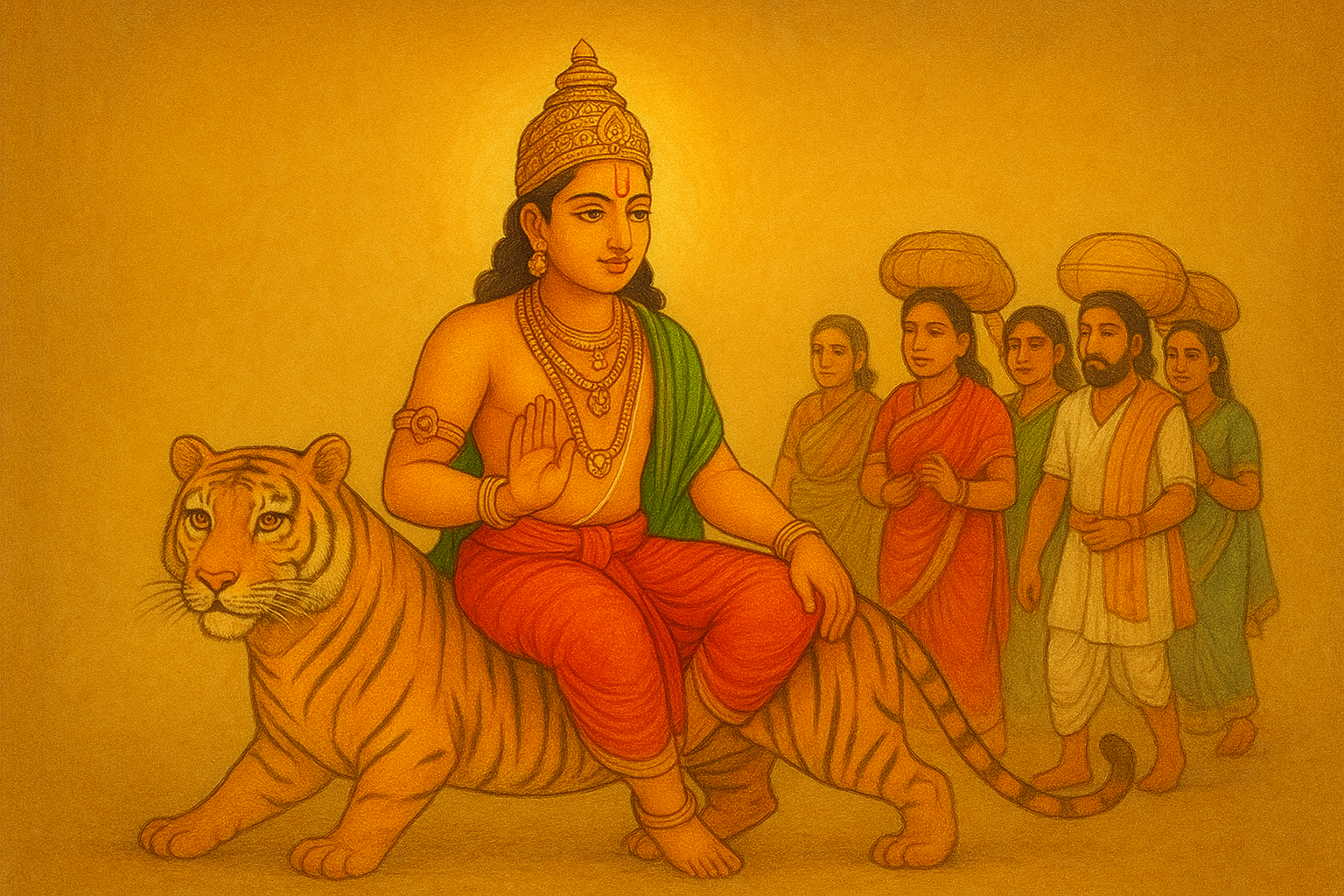
Manikanta accepted the challenge effortlessly. He walked into the dense forests, meditated, and returned seated on a ferocious tiger, with many more tigers following him. The event revealed his divine nature beyond doubt. The king, overwhelmed by fear and devotion, realized his adopted son was truly divine.
The tiger symbolizes:
- Mastery over nature
- Conquering fear
- Supremacy over animal instincts
- Spiritual ascension
The spiritual discipline behind the Ayyappa mala and 41-day vratham reflects this story — devotees must conquer their own inner ‘tiger’ (impulses, emotions, attachments) and reach the divine state of control and purity.
Ayyappa’s Ascension and the Birth of Sabarimala Temple
After proving his divinity, Manikanta revealed his true nature to the king and queen. He instructed the king to build a temple at Sabarimala — a deep forested hilltop in the Western Ghats. He declared that he would eternally reside there as a yogi in meditation.
The posture of the Ayyappa idol — known as Yogapattasana — embodies:
- Control over senses
- Unshakeable discipline
- Mastery of mind and body
- Completeness of vratha (vow)
This posture directly influences the strict discipline of Mandala Deeksha and the Ayyappa mala rules observed today.
The king established the temple as instructed and appointed the Thazhamon Thantri family as the hereditary priests. This lineage continues to oversee Sabarimala rituals even today.
Why the 41-Day Vratham? The Meaning Behind the Number
One of the questions frequently asked online is: “Why is Ayyappa mala worn for 41 days?”
The answer lies in a deep combination of Agama principles, Ayurveda, yogic science, and mental conditioning.
1. Agama Logic: Mandala Period
In Kerala Tantra, a Mandala represents a 41-day spiritual cycle. It is believed that 41 days is the time required for a spiritual vibration to stabilize within a person’s consciousness. Many temple-related vrathams in Kerala follow this model.
2. Yogic Science: Rewiring the Mind
Yogic physiology teaches that it takes approximately 40–48 days to replace old mental patterns and instill new disciplined habits. This aligns perfectly with the goals of Ayyappa Deeksha:
- Mastering senses
- Purifying emotions
- Overcoming addictions
- Developing self-control
- Strengthening one’s willpower
3. Ayurveda: Mind-Body Reset
Ayurveda recognizes the 41-day period as the ideal duration for rejuvenating a person’s physical and mental balance. Certain treatments and herbal cycles in Ayurveda are also 41 days long.
4. Psychological Science: Habit Formation
Modern psychology supports the idea that it takes 30–45 days to break old patterns and build new habits. The strict Ayyappa mala rules align with this principle, creating a structured lifestyle that promotes transformation.
How the Modern Ayyappa Story Shapes the Deeksha Lifestyle
Every story in Ayyappa’s legend reflects a deeper truth about the vratham:
- Manikanta’s upbringing → Discipline, wisdom, compassion
- Mahishi Vadham → Destroying inner negativity
- The tiger story → Conquering fear and instincts
- Temple on Sabarimala → Yogic austerity
- Posture of Ayyappa → Control over senses and mind
These stories explain why devotees are expected to follow strict Ayyappa mala rules, why the discipline of vratham is so intense, and why household members—especially wives—play a supportive role during this spiritual journey.
Read: Complete Ayyappa Mala Rules for Devotees (Full 41-Day Guide)
Chapter 4
Various Names of Lord Ayyappa (Across Puranas, Traditions & Indian Languages)
Lord Ayyappa is one of the most widely worshipped deities in Southern India, and His popularity is rooted in a vast heritage of spiritual traditions, cultural expressions, and ancient scriptural references. Because of His unique divine origin, presence in multiple Puranas, connection with Kerala’s Tantric traditions, and spread across South Indian communities, Lord Ayyappa is known by numerous names. Each of these names reveals a different aspect of His divinity, personality, and role as a protector, yogi, warrior, or guide.
This section presents a detailed compilation of Ayyappa names from Sanskrit Puranas, Agama traditions, Kerala folklore, and regional languages. It also includes the linguistic variations used by millions of devotees across India. The goal is to preserve the sacredness of these names while offering clear explanations about their origins, meanings, and where they are used. This helps establish the universal foundation of Lord Ayyappa in scriptural sources, as well as His cultural richness in local traditions.
Puranic Names of Lord Ayyappa (Sanskrit & Scriptural Sources)
Although the modern story of Manikanta is strongly rooted in Kerala folklore, the divine identity of Ayyappa as Dharma Shasta and Hariharaputra is deeply anchored in ancient Sanskrit literature. Several Puranas mention Shasta as a deity of discipline, protection, and righteousness. In these texts, Shasta appears as a god who safeguards dharma, teaches moral values, and blesses those who follow strict vrathas.
Here are the most important names found in Sanskrit scriptures. For each name, a brief Purana reference is included, following your instruction for Option B.
1. Hariharaputra
Meaning: The Son of Hari (Vishnu) and Hara (Shiva).
Origin: Mentioned in the Brahmanda Purana and Skanda Purana.
Explanation: In the Mohini–Shiva episode, Vishnu takes the form of Mohini, and Shiva unites with that divine form. A radiant child is born from their union. This divine child is later identified as Shasta, who in Kerala becomes Ayyappa.
Usage: Popular in Sanskrit texts, Kerala temples, and among North Indian devotees.
2. Dharma Shasta
Meaning: The Lord of Righteous Conduct.
Purana Reference: Brahmanda Purana describes Shasta as the guardian of dharma.
Explanation: Shasta is portrayed as the deity who maintains cosmic balance through righteousness.
Usage: Most Kerala temples refer to Ayyappa as Dharma Shasta.
3. Shasta / Sastha
Meaning: Teacher, guide, protector.
Reference: Appears in Skanda Purana, Devi Purana, and Bhavishyottara Purana.
Story Summary (Option B): Shasta is depicted as a powerful guardian deity who protects devotees, travels through forests, destroys evil forces, and guides kings and sages.
Usage: Kerala, Tamil Nadu, Sri Lanka, and Karnataka.
4. Bhoothanatha (Lord of the Bhootas)
Purana Source: Devi Purana references Shasta as the leader of ghostly beings who serve him with devotion.
Meaning: Ruler of the bhootas (spiritual beings).
Significance: Indicates Ayyappa’s protective role over hidden energies, spirits, and forest beings.
Usage: Strongly used in Tamil Nadu and Kerala.
5. Mahashasta
Meaning: The Great Shasta.
Scriptural Context: Used in Brahmanda Purana and Tantric rituals describing Shasta’s universal authority.
Usage: Kerala temples, traditional Tantric hymns.
6. Yogeshwara
Meaning: Lord of Yogis.
Reference: Several Shasta stotras and Agamic texts identify Shasta as a master of yoga and self-control.
Story Summary: Shasta meditates in deep tapas, symbolizing spiritual discipline.
Usage: Strong Kerala and Karnataka usage.
7. Jagatpalaka
Meaning: Protector of the Universe.
Scriptural Background: Found in Shasta Sahasranama.
Usage: North Indian and Sanskrit worship.
8. Kaliyuga Varada
Meaning: The one who blesses devotees in the current age.
Reference: Post-Puranic Shasta stotras.
Usage: Devotional hymns in Kerala and Tamil Nadu.
9. Sabari Girisha
Meaning: Lord of the Sabari Hills (Sabarimala).
Explanation: Though not a Purana name, this appears in Sanskrit stotras referring to Ayyappa’s final abode.
Usage: Sabarimala devotees.
10. Sarvajna
Meaning: All-knowing.
Reference: Appears in multiple Shasta stotras.
Usage: Sanskrit and Kerala traditions.
Local & Regional Names of Ayyappa (Kerala, Tamil Nadu, Karnataka, Andhra & Sri Lanka)
The modern cultural identity of Ayyappa is deeply shaped by regional traditions of South India. Kerala folklore contributes the Manikanta story; Tamil Nadu brings Ayyanar traditions; Andhra and Karnataka add linguistic and ritual variations; and Sri Lanka preserves a parallel deity known as Aiyanar. These names reflect cultural evolution over centuries.
1. Ayyappa / Ayyappan
Origin: Kerala.
Meaning: “Younger father” or “Respected one.”
Why this name: Derived from the affectionate term “Appan” used in Kerala.
Where used: Kerala, Tamil Nadu, Karnataka, Andhra, Sri Lanka.
SEO Variants: ayyappa, ayyappan, ayappa, ayyappa swamy.
2. Manikanta / Manikandan
Origin: Kerala legend.
Meaning: The boy with the golden bell around his neck.
Cultural Reason: At birth, Ayyappa appeared with a divine mani (bell).
Usage: Very popular in Kerala and Andhra.
SEO Variants: manikanta swamy, manikandan ayyappan.
3. Ayyanar
Origin: Tamil Nadu folk tradition.
Meaning: Guardian deity.
Connection: Ayyappa is considered a form or extension of Ayyanar tradition.
Usage: Tamil Nadu, Sri Lanka.
SEO Variants: aiyanar.
4. Swami Ayyappa / Ayyappa Swamy
Origin: Telugu usage.
Meaning: Reverential form “Swamy.”
Usage: Andhra, Telangana.
SEO Variants: ayyappa swami, ayyappa swamy photos.
5. Iyyappan / Iyappan
Language: Tamil.
Usage: Tamil Nadu temples and devotional songs.
Reason: Phonetic variation of Ayyappan.
6. Shastavu / Shastaru
Language: Kannada.
Meaning: Kannada form of Shasta.
Usage: Karnataka.
7. Pamba Vaazhi Nadhan
Meaning: Lord who resides by the Pamba river.
Origin: Kerala Sabarimala tradition.
Usage: Kerala devotional songs.
8. Kanni Swamy
Meaning: The Lord of first-year pilgrims.
Usage: Sabarimala tradition.
9. Erumeli Petta Thullal Shasta
Origin: Associated with Ayyappa’s victory over Mahishi.
Usage: Erumeli rituals during Sabarimala season.
10. Guruswami
Meaning: Master of the path.
Usage: Used respectfully for senior devotees leading groups.
11. Aiyanar (Sri Lanka)
Meaning: Tamil guardian deity.
Connection: Strong parallels with Ayyappa seen in rituals and iconography.
Names of Ayyappa in 10 Indian Languages
These names strengthen SEO, local reach, and cultural depth.
1. Ayyappa Names in Malayalam
-
- Ayyappan
- Dharma Sastha
- Manikandan
- Swami Ayyappa
2. Ayyappa Names in Tamil
-
- Ayyappan
- Iyappan
- Ayyanar
- Manikanda Swamy
3. Ayyappa Names in Telugu
-
- Ayyappa Swamy
- Manikanta
- Swamiye
4. Ayyappa Names in Kannada
- Ayyappa Devaru
- Shastavu
- Swami Ayyappa
5. Ayyappa Names in Hindi
- Hariharaputra
- Dharmashastra Dev
6. Gujarati, Marathi, Punjabi, Assamese
These languages use transliterations such as:
- Ayappa Bhagwan
- Hariharaputra
- Dharmashasta
Click to read: Complete Ayyappa Story from Puranas (Full Version)
Chapter 4
Complete Ayyappa Mala Rules: Discipline, Lifestyle, Family Conduct & Scientific Benefits
Wearing the Ayyappa mala and beginning the 41-day Mandala vratham is considered one of the most transformative spiritual practices in Hindu tradition. Devotees believe that the guidance of Lord Ayyappa—also known as Ayyappan, Manikanta, Hariharaputra, Dharma Shasta, and Bhoothanatha—flows directly into one’s life when the vratham is practiced with sincerity, purity, and discipline. The rules of Ayyappa mala are not merely ritual obligations; they are a structured lifestyle system derived from the Agamas, Kerala Tantra, yogic teachings, and centuries of regional practices. They purify the mind and body, strengthen character, improve emotional balance, and prepare the devotee for the pilgrimage to Sabarimala.
This section explains the complete Ayyappa mala rules for men, wives, children, and family members. It also describes the schedule devotees must follow morning, afternoon, and evening, along with food discipline, sleep habits, and mental purity guidelines. These rules are supported by spiritual texts, traditional commentaries, scientific understanding, and psychological logic.
Why Ayyappa Mala Rules Exist: Scriptural and Traditional Explanation
The Ayyappa mala is not an accessory; it is a sacred symbol of commitment to Lord Ayyappa. According to the Ayyappa Tantram and Kerala Agama principles, the mala becomes a spiritual “contract” between the devotee and Dharma Shasta. When a devotee wears the mala, they symbolically enter the life of a brahmachari, a yogi, and a tapasvi. The rules ensure purity of body, clarity of mind, and discipline of senses. These principles echo the divine qualities of Lord Ayyappa, who is described as Yogeshwara (Lord of Yoga), Dharma Shasta, Sarvajna (All-Knowing), and Kaliyuga Varada (Blessing-Giver of the Current Age). By following the rules, devotees align themselves with the vibration of Ayyappa’s consciousness.
In Kerala tradition, the mala rules enable devotees to conquer internal “Mahishi”—representing ego, anger, lust, addiction, laziness, and negativity. The 41-day discipline gradually replaces old mental patterns with new habits of self-control, humility, devotion, and inner strength.
Core Rules of Ayyappa Mala for Devotees
The basic rules apply to all devotees—whether wearing the mala for the first time or as experienced Guruswamys. These principles are universal across Kerala, Tamil Nadu, Andhra Pradesh, Karnataka, and other regions. While the rituals may vary slightly, the discipline remains the same everywhere.
1. Daily Bath and Physical Purity
Devotees must take a bath twice a day—morning and evening. In traditional Kerala practice, cold-water baths are preferred to cultivate inner discipline and bodily resilience. Bathing symbolizes purification and prepares the devotee for worship. Physical cleanliness is considered essential because Lord Ayyappa, in His form as Manikanta and Hariharaputra, is worshipped as the embodiment of yogic purity.
2. Brahmacharya (Celibacy)
Brahmacharya is one of the most important rules of Ayyappa Deeksha. It includes complete control over sexual desire, avoidance of sensual entertainment, and a commitment to inner purity. This rule reflects Ayyappa’s yogic nature, especially His title Yogeshwara. Devotees believe that celibacy redirects physical energy into spiritual awakening, mental clarity, and emotional stability.
3. Food Discipline (Sattvic Diet)
Food forms the foundation of one’s mind. Devotees must follow a vegetarian diet, avoid onion, garlic, outside food, tea, coffee, and addictive substances. Eating simple home-cooked meals helps maintain sattvic energy. Ayyappa, known as Dharma Shasta and Jagatpalaka, is believed to bless those who consume pure food during vratham.
4. Avoid Negative Speech, Anger, and Arguments
Devotees must avoid harsh words, gossip, arguments, lies, and anger. Emotional discipline is considered even more important than physical discipline. According to Agama principles, the words spoken during mala vratham carry powerful karmic weight. Maintaining peace cultivates inner balance and aligns with the compassionate nature of Ayyappa, also called Karuṇamayi Shasta.
5. No Intoxicants or Addictions
Alcohol, tobacco, pan, gutka, and all intoxicants are strictly prohibited. These substances disturb mental clarity and disrupt spiritual energy. The vratham aims to break habitual patterns, and this rule strengthens self-control.
6. Avoid Non-Vegetarian Food
Meat, fish, eggs, and fried food are avoided to maintain sattvic purity. Ayurveda teaches that such foods increase tamasic and rajasic energy, disturbing meditation and mental focus.
7. Wear Only Black, Blue, or Saffron Clothes
These colors symbolize renunciation, devotion, inner strength, and simplicity. Black absorbs negativity, saffron represents spiritual fire, and blue symbolizes divine energy. Most devotees choose black as it represents humility and detachment.
8. Sleep on the Floor
Sleeping on the floor is recommended because it builds discipline, encourages simplicity, and represents the yogic lifestyle of Shasta.
9. Address Everyone as “Swami”
This tradition teaches humility and equality. A devotee must see Ayyappa in every other person. Whether a child, elder, or stranger, everyone is addressed respectfully as “Swami.” This practice dissolves ego and strengthens unity.
10. Daily Satsang and Bhajans
Devotees should participate in daily bhajans, group chanting, or reading spiritual texts. Singing “Swamiye Saranam Ayyappa” increases devotion and mental focus.
11. Visit Temples Regularly
Temple visits purify the mind and create a spiritual atmosphere. Many devotees practice “Girivandanam” (walking around hills) or perform regular poojas to Lord Ayyappa at home.
12. Maintain Strict Time Discipline
Waking up early, performing pooja on time, and following a disciplined schedule is essential. Ayyappa, in His form as Hariharaputra, symbolizes time-consciousness and self-control.
Detailed Daily Routine of Ayyappa Devotees
The discipline of vratham is practiced throughout the day. Here is the expected routine for morning, afternoon, and night.
Morning Discipline
- Wake up before sunrise.
- Take a cold or lukewarm water bath.
- Wear clean clothes (preferably black or saffron).
- Light a deepam and offer prayers to Lord Ayyappa.
- Chant “Swamiye Saranam Ayyappa” at least 108 times.
- Read Ayyappa stotras (Dharma Shasta stotram, Manikanta bhajans).
- Meditate for 10–15 minutes.
- Eat simple sattvic breakfast.
Afternoon Discipline
- Avoid heavy food or daytime sleep.
- Engage in work or daily duties with calmness.
- Maintain purity in thoughts and speech.
- Help others and practice seva (service).
- Repeat Ayyappa namam during short breaks.
Evening Discipline
- Take a second bath.
- Light a lamp in the puja room.
- Perform evening pooja or nama japam.
- Sit for bhajans or satsang.
- Spend time in silence and self-reflection.
- Eat a light, simple dinner.
- Sleep on the floor with minimal bedding.
Ayyappa Mala Rules for Wives and Family Members
The vratham is not only for the devotee but also influences the entire household. Family members play a supportive role in maintaining a peaceful, sattvic environment.
1. Supporting the Devotee’s Discipline
The wife ensures that the home remains calm, clean, and harmonious. This support helps the devotee maintain inner purity.
2. Preparing Sattvic Food
Cooking without onion, garlic, eggs, or heavy masalas supports the devotee’s diet rules.
3. Respecting the Devotee’s Brahmacharya
The wife maintains respectful distance and emotional support. This practice strengthens both partners spiritually.
4. Avoiding Conflicts and Arguments
Peacefulness in the household is essential to protect the devotee’s mental balance.
5. Creating a Positive Environment
Lighting lamps, playing bhajans, keeping the house clean—these small acts increase divine energy in the home.
6. Rules During Menstruation
Traditional belief advises women to rest during menstruation. They may avoid participation in rituals but can support the devotee emotionally.
Scientific and Psychological Benefits of Ayyappa Vratham
The 41-day discipline is not only spiritual; it also has scientific foundations.
1. Habit Formation (Neuroscience)
Modern psychology proves it takes 30–45 days to rewire habits. The vratham uses discipline to reset brain patterns.
2. Improved Mental Health
Reduced anger, reduced stress, calm speech, and regular meditation improve emotional stability.
3. Detoxification (Ayurveda)
A sattvic diet cleanses the digestive system, improves immunity, and stabilizes hormones.
4. Increased Will Power
Celibacy, strict food discipline, and early waking strengthen self-control.
5. Reduced Anxiety Through Chanting
“Swamiye Saranam Ayyappa” chanting regulates breath and calms the nervous system.
Detailed Guide: Ayyappa Mala Rules for Wife & Family Members
Chapter – 5
Significance of Ayyappa Vratham, 41-Day Mandala Duration & Complete Guide to Irumudi Kattu
The Ayyappa vratham is one of the most powerful spiritual disciplines practiced in India. Rooted in centuries of Kerala tradition and supported by Agamic, Tantric, yogic, and Ayurvedic principles, the 41-day Mandala period transforms the devotee physically, mentally, socially, and spiritually. This sacred practice prepares the devotee to experience the divine presence of Lord Ayyappa—celebrated as Dharma Shasta, Hariharaputra, Ayyappan, Manikanta, Bhoothanatha, Sabari Girisha, and Kaliyuga Varada. In this section, we explore the deeper layers of the vratham, the meaning behind the 41 days, and the complete significance of the Irumudi Kattu ritual, which forms the heart of the Sabarimala pilgrimage.
Understanding the 41-Day Mandala Vratham
The 41-day vratham is not just a ritual but a holistic lifestyle transformation. In Kerala’s Tantric tradition, this period is called a Mandala, a cycle of spiritual discipline during which the devotee realigns body, mind, and consciousness. A Mandala represents a complete energy cycle, a period long enough to dissolve negative tendencies and cultivate positive spiritual habits that uplift the devotee.
The vratham prepares the devotee to connect with the energy of Ayyappa, who is revered as Yogeshwara, the supreme lord of yoga and inner discipline. His divine posture in Sabarimala—known as Yogapattasana—symbolizes mastery over the senses, control over desires, and complete focus. Every rule of the vratham mirrors this yogic discipline.
Why 41 Days? The Spiritual, Agamic, Ayurvedic & Psychological Logic
The significance of 41 days is rooted in multiple systems of ancient Indian knowledge. The choice of 41 days is not symbolic; it is functional, intentional, and transformative. Below are the key foundations behind the vratham duration.
1. Agama Tradition: Mandala Shastra
Kerala Agama texts explain that it takes 41 days to complete a cycle of spiritual energy purification. During this period, the devotee becomes a vessel of divine consciousness. Each day removes impurities from the physical body, emotional system, and mental layers. By the end of 41 days, the devotee is spiritually prepared to experience the presence of Lord Ayyappa at Sabarimala.
2. Tantric Logic: Energy Stabilization
Tantra teaches that human energy fluctuates constantly, influenced by food, thoughts, speech, interactions, and environment. A 41-day discipline helps settle spiritual vibrations, allowing awareness to move from outer distractions to inner clarity. The vratham stabilizes kundalini energy and prepares the devotee for the powerful spiritual field at Sabarimala.
3. Yogic Science: Habit Rewiring
In yogic understanding, it takes 40–48 days to break subconscious patterns and create new ones. This aligns with the transformation that Ayyappa vratham seeks. Devotees refrain from anger, lust, intoxication, unhealthy eating, and negative habits. By continuously practicing discipline for 41 days, the mind resets itself.
4. Ayurveda: Complete Body Detox Cycle
Ayurveda prescribes multiple 41-day therapy cycles (known as mandala chikitsa). These cycles rejuvenate internal organs, restore dosha balance, and purify the body. The Ayyappa vratham mirrors this therapeutic cycle through sattvic diet, clean habits, early waking, cold baths, and mild fasting.
5. Psychological Science: The Rule of 40 Days
Modern psychology concludes that emotional habits and behavioral patterns need 30–45 days to change. The vratham uses this principle effectively by creating a structure that gradually transforms thinking, behavior, and emotional reactions.
6. Symbolic Reason: Unity Through Discipline
Devotees believe that following the vratham for 41 days builds inner strength, unity, brotherhood, humility, and devotion. This prepares the devotee to chant “Swamiye Saranam Ayyappa” with full surrender, experiencing the presence of Ayyappan.
Introduction to Irumudi Kattu (Kettunira)
Irumudi Kattu is the central and most spiritually powerful ritual of the Ayyappa pilgrimage. Without the Irumudi, a devotee cannot climb the 18 holy steps of Sabarimala. The word “Irumudi” literally means “two pouches”—a sacred bundle carried on the head by the devotee for the entire journey. This bundle represents purification, surrender, and readiness to approach Dharma Shasta.
The kit is blessed by the Guruswamy and filled with items symbolizing discipline, devotion, and inner transformation. Each item in the Irumudi has spiritual meaning and must be prepared with full devotion.
Structure of the Irumudi
The Irumudi consists of two compartments:
1. The Front Pocket (Munmudi)
This contains offerings to Lord Ayyappa. It is sacred and cannot be opened until the devotee reaches Sabarimala. It symbolizes ego surrender, purity, and devotion. Items include ghee-filled coconut, camphor, incense, coins, flowers, turmeric, kumkum, and prasadam materials.
2. The Back Pocket (Pinmudi)
This pocket contains essential supplies needed for the journey—urad dal, rice, jaggery, snacks, water bottle, a spare set of clothes, and personal items. This symbolizes worldly responsibilities carried with detachment.
Symbolism of Important Irumudi Items
1. Ghee-Filled Coconut (Neythenga)
This is the most sacred offering. The coconut represents the devotee’s head, and the ghee represents impurities being emptied and replaced with divine purity. When this ghee is used for the Nei Abhishekam at Sabarimala, it symbolizes complete surrender to Hariharaputra.
2. Rice and Jaggery
Symbolize abundance, nourishment, and the blessings of Ayyappa as Jagatpalaka.
3. Turmeric and Kumkum
Symbolize purity, power, and protection.
4. Incense Sticks and Camphor
Represent devotion rising upward and the burning away of ego.
5. Coins and Dakshina
Symbolize humility, charity, and detachment.
6. Lime Packets
Used for Pamba purification and removing negativity.
Importance of Guruswamy in Irumudi Kattu
The Guruswamy is a senior, experienced devotee who guides others. He oversees mala dharana, Irumudi Kattu, chanting, rituals, travel arrangements, and discipline. The Guruswamy ensures that devotees maintain the correct Ayyappa vratham principles. He symbolizes the compassionate guidance of Lord Ayyappa Himself, especially in His form as Gurumuni.
Eligibility Rules for Irumudi Kattu
Eligible Devotees
- Devotees who have completed the 41-day vratham.
- Those wearing the Ayyappa mala.
- Those practicing full Ayyappa discipline.
- Kanni Swamys (first-timers) under guidance of Guruswamy.
Ineligible Devotees
- Those not wearing the mala.
- Those who did not observe vratham properly.
- People under intoxication or without mental clarity.
- Anyone violating celibacy and purity rules.
Role of Kanni Swamy (First-Time Devotee)
Kanni Swamys receive special blessings at Sabarimala. Traditions include:
- Guruswamy guiding them closely.
- Offering them pampa tulasi.
- Allowing them to break coconuts first.
- Special prayers at Erumeli Petta Thullal.
- Receiving blessings at Sannidhanam.
They are treated with utmost respect because they symbolize new spiritual beginnings.
Regional Variations in Irumudi Kattu
Kerala Style
Uses traditional materials and local chants in Malayalam. Emphasis on simplicity and purity.
Tamil Nadu Style
Includes unique bhajans, Tamil Ayyappa names like Iyappan, Ayyanar, and practices from Saastha temples.
Andhra–Telangana Style
Includes group bhajans, Telugu chants, and traditions emphasizing community gatherings.
Karnataka Style
Focus on Kannada devotional songs and traditional offerings.
Read the Complete Step-by-Step Irumudi Kattu Guide
Chapter – 6
Ayyappa Vratham Rules: Complete Discipline Guide for 41 Days
Ayyappa vratham is a structured spiritual discipline designed to prepare the devotee for the Mandala–Makaravilakku pilgrimage. These vratham rules are derived from Kerala tantra, Agama guidelines, ancient pilgrimage traditions, and long-established Ayyappa sampradaya. Every rule has a clear objective: to purify behavior, stabilize emotions, and prepare the mind for Lord Ayyappa, revered as Dharma Shasta, Hariharaputra, Ayyappan, and Manikanta. This section explains each vratham rule with its purpose, social logic, psychological meaning, and spiritual foundation.
Core Principles of Ayyappa Vratham
- Simplicity – minimalistic living to reduce ego.
- Brahmacharya – purity of mind and body.
- Ahimsa – avoid harm in thoughts, words, and actions.
- Satya – truthfulness and honesty.
- Samatva – equality of all devotees.
- Seva – service mindset.
- Tyaga – giving up comforts to build inner strength.
These principles reflect Ayyappa’s form as the Yogeshwara, the master of self-control. The vratham rules follow these principles closely.
Daily Routine Rules (Nitya Niyamam)
The vratham requires a structured daily routine for mental clarity and spiritual focus. The purpose is to stabilize thoughts, regulate lifestyle, and maintain sattvic behavior.
Wake Up Before Sunrise
Devotees are expected to wake between 4:00–5:30 AM. Early waking increases discipline and aligns the body with natural rhythms. In Ayyappa tradition, early hours are considered the most sattvic time for chanting “Swamiye Saranam Ayyappa.”
Cold Water Bath Twice Daily
Cold water stimulates circulation and removes lethargy. Symbolically, it purifies body and mind. Tantric traditions consider cold baths essential for maintaining brahmacharya.
Daily Ayyappa Pooja or Diya Lighting
A simple pooja is performed with lamp, incense, flowers, and Ayyappa stotra. The intention is to keep the mind connected to the deity throughout the vratham.
Chanting and Bhajan
Chanting must be done multiple times daily. Popular chants include:
- “Swamiye Saranam Ayyappa”
- “Harivarasanam”
- “Ayyappa Suprabhatham”
- “Dharma Shasta Gayatri”
These chants reinforce devotion and stabilize emotional fluctuations.
Behavioral Discipline Rules (Achara Niyamam)
Follow Brahmacharya Strictly
Brahmacharya is the most important rule of Ayyappa vratham. It is not just abstinence but a state of mental clarity. Devotees avoid romantic thoughts, distractions, entertainment, and conversations that disturb the mind. The objective is to mirror Ayyappa’s yogic form, known across regions as Yogappan, Yogeshwara, and Ayyappa Swamy.
Avoid Anger, Arguments, and Harsh Words
Emotional control builds spiritual strength. Anger increases ego; vratham dissolves ego. Devotees are advised to maintain calm speech and compassionate behavior.
No Consumption of Alcohol, Tobacco, or Intoxicants
Intoxicants disturb clarity and weaken discipline. The vratham demands a pure mind, free of chemical influence.
Avoid Lies, Gossip, Provocation, and Backbiting
These actions create negative energy. The devotee must protect the mind from unnecessary disturbances.
Maintain Humility and Soft Speech
Ayyappa is called Dharma Shasta because He establishes dharma through discipline and humility. The devotee must demonstrate the same qualities.
Food Discipline Rules (Ahara Niyamam)
Food plays a major role in the vratham. A sattvic diet supports mental calmness, purity, and health.
Only Sattvic Food Allowed
- Freshly cooked vegetarian food
- Minimal spices
- No onion, garlic for some groups
- No stale or reheated food
- No overeating
Avoid Foods That Disturb the Mind
- Meat
- Eggs
- Junk food
- Fermented products
- Caffeinated drinks (optional rule)
No Eating Outside
Outside food may contain impurities or tamasic influence. Clean, home-cooked meals maintain discipline.
Dress and Appearance Rules
Ayyappa devotees observe simplicity in clothing to reduce ego and maintain group unity.
Wear Black, Blue, or Saffron Clothing
These colors have specific meanings:
- Black – Absorption, self-control, ego reduction
- Blue – Calmness, devotion, deep focus
- Saffron – Renunciation, purity, yogic discipline
No Fancy Clothing or Jewelry
Vratham emphasizes simplicity. The devotee should avoid showing luxury or pride.
Grow Beard and Avoid Haircuts
This symbolizes dropping physical vanity and focusing on inner growth.
Social Conduct Rules During Vratham
Maintain Respect Toward All
Ayyappa tradition sees all devotees as equals. The phrase “Swami” is used for everyone to remove hierarchy.
Avoid Functions, Gatherings, Movies, Entertainment
Social events may distract the mind. Vratham requires focused lifestyle.
Practice Charity and Helping Others
Seva is central to Ayyappa devotion. Support family members, neighbors, and fellow devotees.
Live a Minimalistic Life
Reduce expenses, reduce consumption, and stay simple.
Rules About Ayyappa Mala
Wear the Mala with Respect
The mala represents Ayyappa’s presence. It must be worn constantly and handled with devotion.
Do Not Remove the Mala Until Vratham Ends
Removing mala breaks discipline. Only Guruswamy or temple priest can remove it during the conclusion ritual.
Avoid Touching Mala Without Bath
Mala must remain pure. Touch only with clean hands.
Restrictions Related to Family, Home, and Social Life
Stay Detached Yet Responsible
Devotee performs all duties but without ego or attachment.
Avoid Sleeping on Cot
Sleeping on floor builds humility and physical discipline.
Avoid Sexual Contact
Essential for brahmacharya. Both physical and mental purity required.
Avoid Arguments with Spouse or Family
Maintains home harmony and prevents energy disturbance.
Role of Women in Supporting Ayyappa Vratham
Women play an important supportive role during vratham. They prepare sattvic food, assist in daily rituals, and maintain a peaceful environment. Many households call Ayyappa devotees as “Swami” as a sign of respect. Tamil Nadu, Kerala, Andhra, Karnataka, and Sri Lanka have similar customs.
This section will link to the detailed blog post “Ayyappa Mala Rules for Wife,” based on Ahrefs and Semrush keyword strategy.
Psychological Foundation Behind Vratham Rules
1. Habit Rewiring
41 days create new behavioral patterns. Discipline becomes natural.
2. Mental Strength Development
Rules eliminate distractions and increase focus.
3. Emotional Stability
Avoiding anger and arguments stabilizes mood.
4. Detoxification
Sattvic diet purifies body and boosts immunity.
5. Social Harmony
Equal treatment of all devotees fosters unity.
Spiritual Meaning Behind Vratham Rules
- Brahmacharya activates spiritual energy.
- Simplicity reduces ego.
- Cold bath increases purity.
- Chanting aligns devotee with Ayyappa’s energy.
- Food rules protect the mind.
- Dress rules symbolize renunciation.
- Helping others builds dharma consciousness.
- Controlling speech purifies thoughts.
These rules prepare the devotee to meet Ayyappa as Dharma Shasta. This spiritual process is acknowledged across regions—Kerala calls Him Ayyappan; Tamil Nadu uses Iyappan; Telugu regions call Him Ayyappa Swamy; Karnataka uses Ayyappa Devaru.
Download Full Vratham Rules PDF (all languages)
Chapter – 7
Ayyappa Mala Dharana: Complete Guide to Meaning, Rules, Colours, Eligibility and Ritual Procedure
Ayyappa mala dharana marks the official beginning of the Mandala vratham. The mala represents surrender, discipline, and readiness to follow the 41-day spiritual path that leads to Sabarimala. Wearing the mala transforms the devotee into a Swamy — an equal, disciplined participant in the path of Dharma Shasta. This section explains everything about Ayyappa mala: rules, colour significance, ritual procedure, types of malas, regional variations, and the spiritual meaning based on Kerala tantra, Agama guidelines, and traditional Ayyappa sampradaya.
Meaning of Ayyappa Mala
Ayyappa mala is not just an accessory. It represents:
- Surrender – the devotee accepts Ayyappa as the guide.
- Discipline – commitment to vratham rules.
- Purity – mind and body enter a sacred phase.
- Equality – every person becomes “Swamy”. No hierarchy.
- Identity – the devotee is recognized as Ayyappa’s follower.
- Protection – considered a shield against negative influences.
The mala symbolizes that the devotee now represents Ayyappan, known across India as Ayyappa, Ayyappan, Manikanta, Hariharaputra, Dharma Shasta, Bhoothanatha, and Swamy Ayyappa.
Types of Ayyappa Mala
Different regions use different types of malas. All are accepted as long as the mala is worn with devotion.
1. Tulasi Mala
Tulasi is considered the most sacred. It purifies the mind and enhances sattvic qualities. Kerala tradition strongly prefers tulasi mala for Kanni Swamy (first-time devotee).
2. Rudraksha Mala
Rudraksha is linked to Lord Shiva. Since Ayyappa is Hariharaputra (son of Shiva and Vishnu in Mohini form), rudraksha mala is spiritually appropriate. Tamil Nadu and Karnataka devotees widely use this type.
3. Tulasi–Rudraksha Combination Mala
Some malas combine tulasi and rudraksha beads. This represents the unity of Shiva (rudraksha) and Vishnu (tulasi), symbolizing the divine nature of Hariharaputra.
4. Gold or Silver-Capped Bead Mala
Not preferred traditionally. Allowed only if the devotee cannot find natural bead malas.
Colours Associated With Ayyappa Mala
Along with the mala, devotees follow colour symbolism. These colours are connected to Ayyappa’s yogic and ascetic nature.
Black – Absorption and Ego Dissolution
Black absorbs energies and represents simplicity. Most Kerala devotees choose black.
Blue – Devotion and Depth of Mind
Blue symbolizes steadiness and calm devotion. This is common in Andhra and Karnataka regions.
Saffron/Orange – Renunciation and Tapasya
Saffron is the colour of sanyasa. This colour is used widely in Tamil Nadu.
Some groups allow white dhotis for pooja days only, but black/blue/saffron remain core colours throughout the vratham.
Eligibility to Wear Ayyappa Mala
Any devotee with faith in Ayyappa can wear the mala, provided he commits to the vratham rules. Eligibility requirements include:
- Physical and mental stability to follow vratham.
- Willingness to follow brahmacharya.
- Acceptance of a simple lifestyle for 41 days.
- Ability to avoid intoxicants, meat, and anger.
- Preparedness to participate in bhajans and pooja.
Special Note for Kanni Swamy (First-Time Devotee)
Kanni Swamy must always be under the guidance of a Guruswamy. Tulasi mala is preferred for first-timers.
People Who Are Not Eligible to Wear Mala
- Those unable to observe celibacy.
- People under intoxication or addiction.
- People with unstable health (doctor guidance recommended).
- Those who cannot maintain daily discipline.
- Devotees involved in social disputes or court matters.
- Those with high anger or uncontrolled behavior patterns.
Mala Dharana Ritual Procedure
The mala dharana ceremony marks the official start of vratham. The ritual is usually performed on:
- Mandala puja beginning day
- Karthika/Chithra Nakshatra day
- Sunday or Monday (preferred)
- Early morning before sunrise
Step-by-Step Mala Dharana Process
- Devotee takes a complete cold bath.
- Wear clean black/blue/saffron clothes.
- Light a lamp in the pooja room.
- Place the mala before Ayyappa photo or idol.
- Guruswamy performs a short pooja.
- Chant “Swamiye Saranam Ayyappa” 108 times.
- Guruswamy places the mala around the devotee’s neck.
- Devotee prostrates and takes blessings from elders.
- Vratham formally begins.
From this moment, the devotee becomes “Swamy”.
Mistakes to Avoid During Mala Dharana
- No casual attitude toward pooja or mala handling.
- No wearing mala with wet or unclean clothes.
- No wearing mala for show or photographs.
- No touching mala without bathing.
- No eating meat after mala dharana.
- No arguments or anger on mala dharana day.
Rules to Follow After Wearing the Mala
1. Keep the Mala Pure
The mala must not touch impure items. Devotee must avoid touching mala with unwashed hands.
2. Avoid Entertainment
No movies, clubs, parties, or activities that disturb calmness.
3. Speak Softly
The devotee must practice mild speech. Anger breaks vratham energy.
4. Maintain Complete Brahmacharya
Both physical and mental brahmacharya are required.
5. Daily Pooja Mandatory
Even a simple lamp-lighting is acceptable.
Regional Variations in Mala Dharana
Kerala Tradition
- Tulasi preferred.
- Strict cold-water bath rules.
- Rituals guided by Guruswamy strongly.
- Black colour dominates.
Tamil Nadu Tradition
- Rudraksha very common.
- Bhajans and group chanting emphasized.
- Saffron clothing widely used.
- More temple gatherings.
Andhra–Telangana Tradition
- Black and blue clothing combined.
- Telugu bhajana samithi culture.
- More home-pooja style mala dharana.
Karnataka Tradition
- Rudraksha common.
- Kannada Ayyappa songs used.
- Simple pooja format.
Spiritual Meaning of Mala Dharana
1. Removal of Ego
The mala reminds the devotee to drop pride and adopt humility.
2. Control of Senses
Mala symbolizes the devotee’s commitment to self-control.
3. Protection and Positivity
Many believe the mala protects the devotee from negative mental states.
4. Connection to Ayyappa’s Yogic Form
Ayyappa’s Yogapattasana posture represents discipline. Mala aligns the devotee with this form.
5. Preparation for Pilgrimage
Mala prepares body, mind, and soul for Irumudi and Sabarimala darshan.
Mala Removal Rules
Mala removal happens only after vratham completion, at:
- Temple
- Home pooja room
- Guruswamy house
Guruswamy removes the mala by chanting “Swamiye Saranam Ayyappa” during the visarjana ritual.
Ayyappa Mala Rules for Wife (Detailed SEO Post)
Chapter – 8
Ayyappa Irumudi Kattu: Complete Ritual Procedure, Items, Rules, and Spiritual Meaning
Irumudi Kattu is the central ritual of the Sabarimala pilgrimage. Without Irumudi, devotees cannot climb the sacred 18 steps. The Irumudi is not a bag — it is a sacred symbol of surrender, discipline, responsibility, and devotion toward Lord Ayyappa, also known as Manikanta, Ayyappan, Hariharaputra, Dharma Shasta, Bhoothanatha, and Swamy Ayyappa. This section explains the complete Irumudi Kattu procedure in a clear, structured, playbook-friendly format.
What Is Irumudi?
The word “Irumudi” means “two-part sacred offering.” It consists of two compartments:
- Munmudi (Front Pocket) – offerings meant for Lord Ayyappa.
- Pinmudi (Back Pocket) – items meant for the devotee’s travel.
Irumudi represents the devotee’s spiritual and worldly responsibilities, carried together with discipline and balance.
Why Irumudi Is Mandatory for Sabarimala
- Symbol of vratham completion.
- Represents surrender of ego.
- Marks readiness to approach the 18 sacred steps.
- Contains ghee-filled coconut used in Nei Abhishekam.
- Acts as a personal vrata sankalpa.
- Connects the devotee to Ayyappa tradition and lineage.
Without Irumudi, devotees cannot enter the Pathinettampadi (18 steps). This rule applies to all regions: Kerala, Tamil Nadu, Karnataka, Andhra, Telangana, and Sri Lanka.
Items Required for Irumudi Kattu (Complete List)
The following items are used for a traditional Irumudi ceremony. Some items vary regionally, but the core structure remains the same.
Mandatory Items
- 1 coconut (cleaned, drilled, filled with pure ghee)
- Rice (raw, clean)
- Jaggery
- Turmeric
- Kumkum
- Camphor
- Agarbatti or dhoop
- Betel leaves and areca nuts (optional)
- Coin dakshina
- Unbroken coconut for rituals
- Lime packets (for Pamba purification)
- Small cloth bag (pavitra paay)
- Traditional Irumudi cloth kit
Optional Regional Items
- Vibhuti (Tamil Nadu)
- Kumkum packets (Andhra)
- Podi prasadam (Kerala)
- Special pooja rice (Karnataka)
Symbolism of Each Irumudi Item
Understanding the meaning of Irumudi items helps devotees connect deeper with Ayyappa’s spiritual path.
Ghee-Filled Coconut (Neythenga)
This is the most important offering. The coconut shell represents the devotee’s body. The emptied coconut symbolizes the removal of ego and impurities. The ghee represents purity that replaces negativity.
Rice
Rice symbolizes nourishment and the wish for prosperity and stability. It also represents life energy (prana shakti).
Jaggery
Represents sweetness of life and positive mindset.
Camphor
Burns without residue, symbolizing ego burning completely.
Turmeric and Kumkum
Symbolize protection, purity, and spiritual energy.
Lime Packets
Used at Pamba to break negative vibrations and purify aura.
Dakshina
Represents charity and humility.
Structure of Irumudi: Munmudi & Pinmudi
Munmudi (Front Compartment)
- Ghee-filled coconut
- Turmeric packet
- Kumkum packet
- Pooja rice
- Camphor
- Incense sticks
- Coin offering
- Flowers or flower powder
Munmudi is sacred and cannot be opened during travel.
Pinmudi (Back Compartment)
- Snacks for journey
- Rice
- Jaggery
- Clothes
- Water bottle
- Personal items
Pinmudi supports the devotee through the journey.
Step-by-Step Irumudi Kattu Procedure
This is the standard ceremony followed across Ayyappa mandirams and homes.
1. Preparation Before Ritual
- Devotee must have completed 41-day vratham.
- Take a cold bath.
- Wear black/blue/saffron clothing.
- Keep pooja room or mandiram clean.
2. Setting Up the Ritual
- Spread a clean cloth on the floor.
- Place Irumudi kit on it.
- Light lamp and incense.
- Place Ayyappa photo or idol at the center.
3. Guruswamy Pooja
- Guruswamy chants basic stotras.
- Devotees chant “Swamiye Saranam Ayyappa.”
- First-time devotees sit closer.
4. Filling the Munmudi
- Ghee-filled coconut is placed gently.
- Camphor, incense, turmeric, kumkum added.
- Coins and flower packets added.
- Cloth tied tightly and sealed.
5. Filling the Pinmudi
- Rice and jaggery added.
- Devotee clothes added.
- Snacks and water placed.
- Pocket tied tightly.
6. Blessings
- Guruswamy blesses Irumudi.
- Devotee carries Irumudi on head.
- Ritual complete — pilgrimage begins.
Rules to Follow With Irumudi
1. Irumudi Must Always Be Carried on the Head
Shoulders allowed. Hands holding not allowed except during adjustments.
2. Never Placed on Floor
Place only on sacred surfaces (wooden plank, cloth, or another Swamy’s hands).
3. Avoid Wet or Dirty Places
Maintain purity of Munmudi.
4. No Arguments During Travel
Maintains sanctity of the journey.
5. No Alcohol, Meat, Smoking
Even on travel days, vratham rules remain strict.
Chanting Rules During Journey
- “Swamiye Saranam Ayyappa” every few minutes.
- Malayalam, Tamil, Telugu, Kannada versions accepted.
- Bhajans recommended during group travel.
Spiritual Meaning of Irumudi
1. Represents Dual Nature of Life
Mundane and spiritual responsibilities balanced together.
2. Symbol of Ego Removal
Ghee-filled coconut represents emptying the mind.
3. Represents Ayyappa’s Yogic Discipline
Carrying Irumudi trains posture, patience, humility.
4. Symbol of Protection
Munmudi protects the devotee spiritually throughout journey.
Kanni Swamy Irumudi (First-Time Devotees)
Kanni Swamys receive special respect during Irumudi:
- They break the coconut first at Pamba.
- They walk in front of the group.
- Guruswamy personally guides them.
- They participate in Pettathullal more actively.
Common Mistakes to Avoid
- Opening Munmudi during journey.
- Placing Irumudi directly on ground.
- Using plastic items excessively.
- Neglecting chanting.
- Carrying unnecessary luggage.
Download Complete Irumudi Checklist (PDF)
Chapter 9
Ayyappa Pathinettam Padi: Complete Meaning, Symbolism, Rules and Sacred Rituals of the 18 Holy Steps
The Pathinettam Padi — the 18 holy steps of Sabarimala — are the most powerful and iconic symbol of the Ayyappa pilgrimage. Only devotees carrying the Irumudi Kattu are allowed to climb these sacred steps. Each of the 18 steps represents a spiritual milestone. Every step holds layers of meaning drawn from Kerala Tantra, Ayyappa Agama traditions, yogic symbolism, and ancient folklore. This section presents a complete and structured understanding of the Pathinettam Padi, written in scannable, SEO-friendly format.
Why the 18 Holy Steps Are Important
- They represent transformation from worldly life to divine consciousness.
- They symbolize the disciplined path of Ayyappa vratham.
- Only devotees with Irumudi can climb, signifying commitment.
- They connect the devotee to the spiritual lineage of Dharma Shasta.
- Each step removes a layer of ego, impurity, or limitation.
The 18 steps act as the final gateway to Ayyappa’s sannidhanam, where He is worshipped as Ayyappan, Manikanta, Hariharaputra, Bhoothanatha, and Dharma Shasta.
Symbolic Meaning of the 18 Steps
The most accepted interpretation is that the 18 steps represent three major dimensions:
- 1 – Five Senses (sight, smell, taste, hearing, touch)
- 2 – Eight Negative Qualities (kama, krodha, lobha, moha, mada, matsarya, ahankara, anasana)
- 3 – Three Gunas (sattva, rajas, tamas)
- 4 – Two Forms of Ignorance (spiritual and worldly)
These add up to 18 — representing the complete purification of human nature.
Alternative Interpretations of the 18 Steps
1. Tantra-Based Interpretation
The 18 steps represent the chakric ascent from muladhara to sahasrara. The devotee climbs symbolically from survival consciousness to divine consciousness. Each step purifies one energy point.
2. Agama Interpretation
Agama texts refer to 18 forms of Dharma Shasta worshipped across South India. Each step represents one form: Ayyanar, Kshetrapala Shasta, Kalyana Shasta, Veera Shasta, Arya Shasta, Bhoothanatha, etc.
3. Kerala Traditional Interpretation
The 18 steps represent:
- 10 Indriyas
- 5 Pranas
- Mind, Intellect, Ego
This interpretation is used by several Guruswamis during pilgrimage explanations.
Meaning of Each Step (Step-by-Step Explanation)
Step 1 – Sense of Sight
Purifies the way devotee perceives the world.
Step 2 – Sense of Smell
Controls impulses attached to desires.
Step 3 – Sense of Taste
Represents sattvic diet and purity.
Step 4 – Sense of Hearing
Focus on chanting “Swamiye Saranam Ayyappa.”
Step 5 – Sense of Touch
Purifies emotional reactions.
Step 6 – Kama
Desire purified through brahmacharya.
Step 7 – Krodha
Anger removed through discipline.
Step 8 – Lobha
Greed dissolved through charity.
Step 9 – Moha
Attachment controlled through simplicity.
Step 10 – Mada
Pride removed through humility.
Step 11 – Matsarya
Jealousy removed through equality.
Step 12 – Ahankara
Ego reduced through surrender.
Step 13 – Anasana
Gluttony removed through dietary rules.
Step 14 – Sattva
Purity cultivated.
Step 15 – Rajas
Activity balanced.
Step 16 – Tamas
Laziness overcome.
Step 17 – Spiritual Ignorance
Removed through Ayyappa devotion.
Step 18 – Worldly Ignorance
Removed through self-awareness.
Rules for Climbing the 18 Steps
Rule 1: Only Irumudi Devotees
No one can climb without Irumudi Kattu. This rule is universal across all regions.
Rule 2: Climb Barefoot
Footwear not allowed on sacred steps.
Rule 3: Chant “Swamiye Saranam Ayyappa”
Chanting purifies mind and surroundings.
Rule 4: No Overtaking or Rushing
Climb steadily, with humility.
Rule 5: Carry Irumudi on Head
Touching with hands only allowed for support.
Restrictions on the 18 Steps
Certain devotees cannot climb the Pathinettam Padi:
- Devotees without Irumudi
- Those who have not completed vratham
- Pilgrims in wheelchairs (alternate entrance provided)
- People lacking physical stability
- Menstruating women (based on Sabarimala age tradition)
Rituals Performed at the 18 Steps
1. Breaking the Coconut
Represents shattering the ego.
2. Nei Abhishekam
Ghee from the Irumudi coconut used for abhishekam.
3. Touching the Steps with Forehead
Symbol of humility.
4. Offering Flowers or Rice
Represents gratitude.
5. Climbing with Chanting
Every step taken with devotion.
Why Only Irumudi Devotees Can Climb the Steps
This rule originates from ancient Kerala Tantra:
- The devotee must arrive in purified state.
- Irumudi acts as spiritual permission.
- Irumudi represents responsibility and surrender.
- 18 steps are considered alive (divine energy seats).
Agama texts describe the Pathinettam Padi as a yantra-based gateway, requiring the devotee to be in vratham state.
Regional Interpretations of the 18 Steps
Kerala Interpretation
Focuses on ego removal and spiritual elevation.
Tamil Nadu Interpretation
Focuses on Ayyanar–Shasta connections.
Andhra–Telangana Interpretation
Steps represent the path of dharma from ignorance to realization.
Karnataka Interpretation
Steps seen as symbol of yogic ascent.
Colour Symbolism at the 18 Steps
- Black – ego removal
- Blue – devotion
- Saffron – renunciation
Misconceptions About the 18 Steps
Myth: Women cannot climb because they are inferior
Correction: Rule is based on the Ayyappa vratham age tradition, not gender inferiority.
Myth: Anyone can climb if they pay money
Correction: Without Irumudi, climbing is prohibited.
Myth: 18 steps are only symbolic
They also represent energy points in Tantra.
Detailed Explanation of 18 Steps (Deep Purana Version)
Chapter – 10
Psychological, Emotional, and Spiritual Transformation During Ayyappa Vratham
Ayyappa vratham is more than a set of ritual rules. It is a structured 41-day transformation system that reshapes the devotee’s mind, emotions, behavior patterns, and spiritual awareness. The vratham aligns the individual with the disciplined energy of Lord Ayyappa, worshipped throughout India as Ayyappan, Manikanta, Hariharaputra, Dharma Shasta, Bhoothanatha, and Kaliyuga Varada. This section explains how the vratham transforms the inner self using ancient wisdom, psychological principles, spiritual science, and yogic practices.
Why Ayyappa Vratham Causes Transformation
- Breaks old habit loops through disciplined routine.
- Cleanses the mind by removing negative thoughts.
- Purifies emotions by reducing anger and attachment.
- Strengthens willpower through brahmacharya and diet control.
- Builds patience through daily rituals.
- Improves social behavior through humility and service.
- Opens spiritual awareness through chanting and meditation.
These outcomes are not accidental; they are built into the vratham structure.
Psychology of Ayyappa Vratham: Brain and Behavior Changes
The vratham transforms thought patterns through repetition and discipline. Neuroscience shows that new habits form when performed for 30–45 days. The vratham’s 41-day duration perfectly matches the time required to create permanent cognitive and behavioral changes.
1. Reduction of Mental Clutter
Daily chanting of “Swamiye Saranam Ayyappa” reduces mental noise. The mind becomes quieter and more focused. Repetitive mantra sound stabilizes the amygdala, lowering stress and emotional reactivity.
2. Strengthening of Prefrontal Cortex
Sticking to vratham rules trains the brain’s frontal lobe, improving decision-making, impulse control, and discipline.
3. Neuroplasticity Through Discipline
Following the same routine daily rewires the brain. This builds new circuits related to devotion, awareness, and inner stability.
4. Emotional Healing
Anger reduces. Anxiety decreases. The vratham helps overcome depression-like patterns by building meaning and purpose.
Emotional Transformation During Vratham
Every Ayyappa devotee experiences emotional purification. The vratham is designed to stabilize emotions and build emotional maturity.
1. Reduction of Anger
Controlling speech, avoiding arguments, and practicing humility reduce triggers. Devotees gain emotional balance.
2. Increased Patience
Waking early, performing poojas, waiting in long queues, and traveling long distances cultivate patience.
3. Reduction of Attachment
The minimalist lifestyle reduces emotional dependency, strengthening inner sense of freedom.
4. Compassionate Behavior
Calling everyone “Swamy” promotes respect and empathy.
Behavioral Transformation During Vratham
The vratham shapes behavior through discipline:
- Speaking gently
- Helping others
- Avoiding lies
- Practicing compassion
- Being punctual
- Avoiding addictions
- Becoming self-aware
This aligns with the qualities of Ayyappa, also known as Dharma Shasta, the upholder of righteous conduct.
Spiritual Transformation During Vratham
The vratham is designed to awaken the inner spiritual energy of the devotee.
1. Awakening of Bhakti Shakti
Daily chanting increases devotion and spiritual intensity.
2. Purification of Subtle Body
Food control, cold baths, and celibacy purify energy layers called koshas.
3. Strengthening of Prana
Chanting regulates breath. Meditation stabilizes pranic flow.
4. Ego Reduction
Wearing black/saffron, sleeping on the floor, and simplicity remove ego-based identity.
5. Expansion of Consciousness
The vratham slowly shifts awareness from body-centered to divine-centered.
How the Vratham Impacts Family Life
The vratham changes the devotee and influences the entire household.
1. Increases Peace at Home
Soft speech and emotional control spread calmness.
2. Encourages Healthier Eating
Sattvic meals benefit the whole family.
3. Reduces Conflicts
Devotee avoids arguments; family atmosphere becomes more harmonious.
4. Family Unites in Support
Wife, parents, and children often help with pooja, food, and discipline.
Career and Lifestyle Benefits from Vratham
1. Improved Focus
Daily rituals strengthen concentration.
2. Enhanced Leadership and Responsibility
Discipline builds inner leadership qualities.
3. Stress Reduction
Breath regulation and chanting lower stress hormones.
4. Increased Energy Levels
Sattvic food and cold baths boost metabolism.
Common Struggles During Vratham and How to Overcome Them
1. Physical Fatigue
Solution: Follow sattvic diet; avoid heavy food; get enough rest.
2. Emotional Irritation
Solution: Increase chanting during stressful moments.
3. Cravings for Addictions
Solution: Drink warm water; practice bhajans.
4. Difficulty in Brahmacharya
Solution: Avoid triggers; engage in satsang; maintain mind purity.
5. Social Pressure
Solution: Stay committed; explain vratham politely to others.
Ayurvedic Interpretation of Vratham
Ayurveda supports the vratham as a detox process.
Body Benefits
- Liver purification
- Improved digestion
- Reduced inflammation
- Stable metabolism
- Reduced toxins (ama)
Mind Benefits
- Better sleep
- Reduced anxiety
- Stronger memory
- Higher clarity
Tantric Interpretation of Vratham
Kerala Tantra explains vratham as an energy purification process.
1. Purification of Chakras
Chanting activates throat and heart centers.
2. Activation of Sushumna
Brahmacharya redirects physical energy inward.
3. Stability of Prana
Cold baths stabilize pranic movement.
4. Strengthening of Tejas (Inner Fire)
Sattvic food increases subtle radiance.
Stages of Transformation During Vratham
Stage 1: Physical Discipline (Days 1–10)
Body adjusts to new routine.
Stage 2: Emotional Purification (Days 11–20)
Old emotional patterns dissolve.
Stage 3: Mental Stability (Days 21–30)
Thoughts become clear and focused.
Stage 4: Spiritual Awakening (Days 31–41)
Devotee experiences deep devotion and inner peace.
Why People Experience Miracles During Vratham
Miracles occur due to:
- Heightened awareness
- Reduced ego
- Purified mind
- Focused prayer
- Positive intention
When mind becomes clear and heart becomes pure, devotees feel Ayyappa’s presence more intensely.
Integration of Ayyappa Names in Emotional Transformation
Each Ayyappa name influences a psychological quality:
- Dharma Shasta – integrity
- Hariharaputra – balance
- Bhoothanatha – courage
- Manikanta – purity
- Ayyappan – compassion
- Kaliyuga Varada – hope
Repeating these names deepens emotional healing.
Deep Psychology of Ayyappa Vratham
Chapter 11
Ayyappa Temple Etiquette: Complete Rules, Dress Code, Conduct, and Spiritual Logic
Sabarimala is one of the most disciplined pilgrimage centers in the world. Devotees follow a strict code of conduct inside the temple environment. These rules protect the sanctity of the temple, support the energy system of the shrine, and maintain harmony among millions of devotees. Ayyappa, worshipped as Ayyappan, Manikanta, Hariharaputra, Bhoothanatha, Dharma Shasta, and Swamy Ayyappa, is approached with humility, discipline, and purity. This section explains the complete etiquette expected at Sabarimala and other Ayyappa temples.
Why Temple Etiquette Is Important
- Maintains purity of sacred space.
- Protects the spiritual energy around the sanctum.
- Ensures smooth movement of large crowds.
- Prepares the devotee to experience Ayyappa’s presence.
- Preserves ancient traditions of Dharma Shasta worship.
- Prevents disturbances and maintains peace.
Temple etiquette is a continuation of the vratham discipline. Devotees must follow the same principles inside the temple environment.
The Journey to Sabarimala: Etiquette Steps
1. Etiquette at Pamba River
Pamba is considered the purifying gateway to Sabarimala. Devotees must behave with respect at this holy site.
- No loud talking or shouting.
- No bathing with soap or detergents.
- No wasting water.
- No disrespectful behavior toward trees or river banks.
- No eating meat or drinking alcohol anywhere near Pamba.
Devotees must take a simple holy dip with humility. Ayyappa is worshipped here as Pamba Vaazhi Nadhan — the Lord who resides along the Pamba path.
Etiquette While Climbing Sabarimala Hill
Stay in Groups When Possible
Group discipline ensures safety and prevents crowd issues.
Maintain Rhythm of Chanting
Preferred chant: “Swamiye Saranam Ayyappa”. Other regional versions accepted.
Do Not Push or Rush
Climb at a steady pace. Respect senior devotees.
Do Not Overtake Aggressively
Overtaking can cause imbalance for devotees carrying Irumudi.
Be Compassionate
Offer support to tired devotees. Dharma Shasta represents compassion and correctness.
Dress Code Etiquette at Sabarimala
The dress code reflects simplicity and vratham purity. Allowed colors include:
- Black – austerity
- Blue – devotion
- Saffron – renunciat
Chapter – 12
Ayyappa Prasadam: Complete Guide to Offerings, Ritual Materials, Temple Variations, and Symbolic Meaning
Prasadam plays a central role in Ayyappa worship. Every offering, every material, and every ritual item carries spiritual, symbolic, and cultural significance. Ayyappa, worshipped across India as Ayyappan, Manikanta, Hariharaputra, Dharma Shasta, Bhoothanatha, and Swamy Ayyappa, receives offerings that reflect His yogic nature, protective qualities, and dharmic energy. This section presents a detailed guide to all prasadam items used in Sabarimala, local Ayyappa temples, and home pooja traditions.
Why Prasadam Is Important in Ayyappa Worship
- Connects the devotee directly with Ayyappa’s blessings.
- Purifies mind through taste, aroma, and ritual consumption.
- Symbolizes equality — prasadam is shared by all devotees.
- Represents surrender through offering of food and items.
- Balances physical and spiritual energies.
Prasadam is a core part of Dharma Shasta worship tradition.
Main Prasadam Items at Sabarimala
Sabarimala is known for its unique prasadam system. Each item has a specific meaning and historical connection.
1. Aravana Payasam
Aravana is the most famous Ayyappa prasadam. It is made with:
- Jaggery
- Rice
- Ghee
- Dry ginger
- Cardamom
Meaning and symbolism:
- Represents sweetness of devotion.
- High energy food for pilgrims.
- Symbol of prosperity and health.
- Jaggery purifies blood; ginger aids digestion.
2. Appam
Appam is made from jaggery, rice flour, and ghee. It symbolizes:
- Simplicity of the devotee’s heart.
- Warmth of devotion.
- Joy and auspiciousness.
3. Nei Abhishekam Prasadam
Ghee used in abhishekam to Ayyappa is offered back as prasadam.
Symbolizes:
- Removal of ego (coconut emptied and filled with ghee).
- Devotee’s purification.
- Grace of Hariharaputra.
4. Vibhuti
Represents:
- Detachment from material world.
- Protection from negative energies.
- Connection with Shiva — Ayyappa’s father.
5. Kumkum
Kumkum symbolizes:
- Shakti energy.
- Purity of worship.
- Auspiciousness in daily pooja.
Secondary Prasadams in Ayyappa Temples
Other Ayyappa temples follow variations based on regional culture, but core items remain similar.
Common Prasadams
- Aval (poha)
- Pori (puffed rice)
- Rava kesari
- Chakkara pongal
- Chitranna (lemon rice)
- Pongal (salt or sweet)
- Coconut pieces
Symbolism of These Prasadams
- Aval – simplicity and humility.
- Pori – lightweight spirit and balance.
- Coconut – purity and devotion.
- Pongal – abundance.
- Lemon rice – mental clarity.
Complete Table of Ayyappa Prasadams and Their Meanings
| Prasadam | Ingredients | Symbolic Meaning |
|---|---|---|
| Aravana Payasam | Jaggery, rice, ghee | Sweet devotion, energy |
| Appam | Rice, jaggery, ghee | Auspicious beginnings |
| Nei Abhishekam | Pure ghee | Ego removal, purity |
| Vibhuti | Sacred ash | Detachment, protection |
| Kumkum | Turmeric powder base | Shakti energy |
How to Receive Prasadam Respectfully
Devotees must follow proper etiquette when receiving prasadam at Sabarimala or any Ayyappa temple.
- Receive with right hand or cupped hands.
- Do not waste any prasadam.
- Do not drop items on floor.
- Share prasadam with humility.
- Accept without complaining about quantity.
Ayyappa is called Dharma Shasta — the Lord of righteousness. Respectful acceptance of prasadam upholds dharma.
Home Pooja Prasadam Preparation
Families prepare prasadam at home, especially during vratham or before Irumudi Kattu.
Guidelines for Home Preparation
- Kitchen must be clean.
- Use fresh ghee and jaggery.
- No tasting while cooking.
- Cook with prayerful mindset.
- Offer first to Ayyappa before anyone eats.
Popular Home Prasadams
- Appam
- Pongal
- Aval mixture
- Ney payasam
- Coconut pieces
Regional Variations of Ayyappa Prasadam
Kerala Style
- Aravana
- Appam
- Ney payasam
Tamil Nadu Style
- Pongal
- Chakkarai pongal
- Sundal
Andhra–Telangana Style
- Aval mixture
- Pulihora (lemon rice)
Karnataka Style
- Kesaribath
- Pongal with cashews
Symbolic Colors in Prasadam
- Golden/Brown (Jaggery) – divine sweetness.
- Black (Appam cooked edge) – tapas and discipline.
- Red (Kumkum) – Shakti and blessings.
- Blue-tinted containers – devotion and purity.
Prasadam Distribution Etiquette
Proper behavior during prasadam distribution ensures harmony.
- Stand in queue without pushing.
- Accept prasadam silently.
- Move aside immediately after receiving.
- Share with others courteously.
- Avoid waste at all costs.
Ayyappa Names Related to Prasadam Rituals
- Bhoothanatha – protector during travel.
- Hariharaputra – symbol of purity.
- Ayyappan – joy and auspiciousness.
- Manikanta – compassion.
- Dharma Shasta – righteousness in offerings.
Spiritual Logic Behind Prasadam
- Food becomes spiritually charged after offering.
- Symbolizes unity and equality.
- Balances prana (life energy).
- Direct blessing from Ayyappa through consumption.
- Purifies both mind and body.
Common Mistakes to Avoid
- Throwing prasadam.
- Taking more than needed.
- Comparing prasadam quality.
- Handling with dirty hands.
- Leaving prasadam unconsumed.
Complete Guide to Aravana & Appam (Separate Blog)
Chapter – 13
Ayyappa Bhajans, Mantras, and Chanting Practices: Complete Guide to Sacred Sound Traditions
Chanting is the heart of Ayyappa worship. Every devotee, whether in Kerala, Tamil Nadu, Karnataka, Andhra, Telangana, or Sri Lanka, connects with Ayyappa through sacred sound. Ayyappa is worshipped through different names — Ayyappa, Ayyappan, Swamy Ayyappa, Manikanta, Hariharaputra, Dharma Shasta, Bhoothanatha — and each name carries spiritual vibrational power. This section explains the complete chanting system, mantras, bhajans, rules, benefits, and regional traditions.
Why Chanting Is Central to Ayyappa Worship
- Chanting stabilizes the mind.
- Creates devotional atmosphere around the devotee.
- Purifies emotional patterns and reduces stress.
- Strengthens vratham discipline.
- Connects group devotees through shared vibrations.
- Prepares the mind for darshan.
- Activates devotion (bhakti shakti).
- Controls negative thoughts naturally.
Sound is a powerful spiritual tool. Ayyappa tradition emphasizes continuous chanting as a core vratham practice.
Primary Ayyappa Chant: “Swamiye Saranam Ayyappa”
Meaning
Swamiye – O Lord
Saranam – I seek refuge
Ayyappa – The one who protects through dharma
This chant represents complete surrender to Ayyappa. It is the most powerful Ayyappa sound mantra used throughout pilgrimage, vratham, Irumudi Kattu, queue movement, and darshan.
Benefits
- Removes fear.
- Reduces anxiety.
- Purifies thoughts.
- Stabilizes breathing.
- Boosts confidence.
- Creates unity among devotees.
Ayyappa Gayatri Mantra
Bhuthabalaya Dheemahi
Tanno Shastah Prachodayat”
Meaning
We meditate on Bhoothanatha (protector).
We contemplate on the powerful Ayyappa.
May Dharma Shasta guide our intellect.
Purpose
- Enhances inner strength.
- Invokes divine guidance.
- Strengthens mental clarity.
- Purifies intellect (buddhi shuddhi).
Ayyappa Moola Mantra (Seed Mantra)
Moola mantras activate spiritual energy quickly. “Manikanta Swami” refers to the divine child with the bell around His neck, connecting devotees to purity and innocence.
Powerful Additional Ayyappa Mantras
1. Hariharaputra Mantra
Invokes Ayyappa as the son of Shiva and Vishnu. Represents balance and unity.
2. Dharma Shasta Mantra
Strengthens discipline, justice, and righteous conduct.
3. Bhoothanatha Mantra
Invokes Ayyappa as the protector of devotees.
Harivarasanam (Ayyappa Lullaby)
Harivarasanam is sung at Sabarimala every night before the sanctum is closed. It is considered a sacred farewell to Ayyappa for the day.
Purpose
- Calms the mind.
- Creates emotional surrender.
- Symbolizes offering of day’s spiritual work.
- Associated strongly with Sabarimala tradition.
Types of Ayyappa Bhajans
1. Traditional Kerala Bhajans
- Slow rhythm.
- Deep melody.
- Focus on devotion and surrender.
2. Tamil Nadu Bhajan Sampradaya
- Energetic pitch.
- Complex group responses.
- Use of mridangam and cymbals.
3. Andhra–Telangana Ayyappa Bhajans
- Fast-paced rhythm.
- Clear Telugu pronunciation.
- Focus on vratham discipline and moral teachings.
4. Karnataka Bhajans
- Deep-toned songs.
- References to Ayyappa Devaru.
- Use of native percussion instruments.
Daily Chanting Schedule During Vratham
Morning (5 AM – 7 AM)
- Swamiye Saranam Ayyappa (108 times).
- Ayyappa Gayatri.
- Hariharaputra Mantra.
Noon
- Simple chanting for 5–10 minutes.
- Moola mantra repetition.
Evening (6 PM – 8 PM)
- Group bhajans if possible.
- Harivarasanam before sleep.
Chanting strengthens vratham discipline and resets emotional patterns.
Rules During Chanting
1. Sit in Clean Space
Preferably facing east.
2. Maintain Straight Posture
Supports breath flow.
3. Avoid Eating or Drinking Mid-Chant
Maintains energetic purity.
4. Chant with Respect
Do not chant casually.
5. Avoid Negative Thoughts During Chanting
Mantra power increases when mind is calm.
Group Bhajans and Their Importance
Group chanting amplifies collective energy. It creates unity among devotees and supports vratham discipline. Regions like Tamil Nadu, Andhra, and Kerala conduct large bhajan gatherings known as Ayyappa Padi Pattu, Pattu Satsang, or Bhajana Mandali.
Benefits of Group Bhajans
- Reduces loneliness during vratham.
- Deepens emotional connection to Ayyappa.
- Strengthens community relationships.
- Improves vocal confidence and devotion.
Nada Yoga: Sound Science Behind Ayyappa Chanting
Chanting affects the body physiologically and spiritually.
1. Vibration Resonance
Mantras vibrate through chest and throat chakras, balancing emotional flow.
2. Breathing Stability
Chanting naturally slows breath and reduces stress.
3. Heart–Brain Synchronization
Mantra rhythm aligns heartbeat with thought patterns.
4. Detoxification
Chanting purifies nasal passages and improves oxygen intake.
Regional Chant Variations (Language-Based)
Kerala (Malayalam)
- “Saranam Ayyappa.”
- “Harivarasanam.”
- Deep nasal pronouncement.
Tamil Nadu
- “Swamiye Saranam Ayyappa.”
- Iyappan bhajan style.
Telugu (Andhra–Telangana)
- “Ayyappa Swamy Saranam.”
- Clear and rhythmic patterns.
Kannada
- “Ayyappa Devaru Saranam.”
- Slow and deep-chested chants.
Chanting Mistakes to Avoid
- Chanting lazily.
- Rushing through mantras.
- Chanting with negative thoughts.
- Breaking chanting rules frequently.
- Chanting without awareness of meaning.
- Using chants for showing off.
Benefits of Ayyappa Chanting
Mental Benefits
- Reduces stress.
- Improves memory.
- Increases focus.
Emotional Benefits
- Stabilizes emotions.
- Reduces anger.
- Improves patience.
Spiritual Benefits
- Deepens devotion.
- Purifies aura.
- Opens inner awareness.
Detailed Ayyappa Mantra Meanings
Chapter 14
Ayyappa Sahasranamavali, Ashtottara Shatanamavali, and Name Significance: Complete Guide
Ayyappa worship places strong emphasis on the chanting of names. Each name of Ayyappa represents a unique divine quality. Devotees across Kerala, Tamil Nadu, Karnataka, Andhra, Telangana, and Sri Lanka use these names in pooja, bhajans, vratham, and meditation. Ayyappa is worshipped as Ayyappan, Manikanta, Hariharaputra, Dharma Shasta, Bhoothanatha, Kaliyuga Varada, and many other names with deep spiritual meaning. This section explains the concept behind Ayyappa Sahasranamavali, Ashtottara Shatanamavali, and regional name traditions.
Why Ayyappa Has Many Names
- Ayyappa appears in multiple forms across regions.
- Different communities experienced Ayyappa’s grace in different ways.
- Each Purana mentions Ayyappa using unique titles.
- Names represent Ayyappa’s powers, qualities, and roles.
- Local cultures added affectionate names over time.
- Temple traditions preserve ancient naming patterns.
Names reflect Ayyappa’s universal appeal and diverse devotional traditions.
Difference Between Sahasranamavali and Shatanamavali
Sahasranamavali (1000 Names)
- Collection of 1000 divine names.
- Describes all aspects of Ayyappa.
- Used mostly in extended poojas and mandala pujas.
- Considered highly powerful for vratham energy.
Ashtottara Shatanamavali (108 Names)
- Collection of 108 names.
- Used widely in daily pooja.
- Easier to chant daily during vratham.
- Represents complete life-cycle symbolism.
Both serve unique purposes in Ayyappa worship.
Origin of Ayyappa Names
Ayyappa names come from multiple sources:
1. Purana-Based Names
Names found in Brahmanda Purana, Skanda Purana, Bhavishyottara Purana, and Shiva Purana.
- Dharma Shasta
- Hariharaputra
- Bhoothanatha
- Mahashasta
- Arya Shasta
- Veera Shasta
2. Agama & Tantra Names
- Yogeshwara
- Kalyana Shasta
- Jnana Shasta
- Saranga Shasta
3. Regional Names
Kerala
- Ayyappan
- Manikanta
- Sabari Girisha
- Pamba Vaazhi Nadhan
Tamil Nadu
- Iyappan
- Ayyanar (related folk tradition)
- Shasta Perumal
Andhra–Telangana
- Ayyappa Swamy
- Swamiye Ayyappa
Karnataka
- Ayyappa Devaru
- Shastaru
The diversity shows Ayyappa’s wide devotional landscape.
Categories of Ayyappa Names
1. Yogic Names
- Yogeshwara
- Yogappan
- Nitya Yogi
These names highlight Ayyappa as the ultimate ascetic.
2. Warrior Names
- Veera Shasta
- Bhoothanatha
- Kshetrapala Shasta
These names represent protection and strength.
3. Compassionate Names
- Manikanta
- Kaliyuga Varada
- Ayyappan
These names symbolize mercy and grace.
4. Purity & Discipline Names
- Dharma Shasta
- Satyavrata
- Pavamaneshwara
These names relate to vratham qualities.
5. Temple-Specific Names
- Sabarigirisha
- Pettai Shasta
- Pamba Nadhan
How Ayyappa Names Are Used in Pooja
1. Daily Shatanamavali Chanting
108 names chanted after lighting lamp.
2. Mandala Pooja
Sahasranamavali used for extended rituals.
3. Irumudi Kattu
Chanting names while preparing ghee-filled coconut.
4. Temple Bhajans
Names used as lead lines in bhajans across South India.
5. Meditation
Devotees meditate on chosen names like Hariharaputra or Manikanta.
Rules for Chanting Ayyappa Names
- Sit in clean place.
- Keep lamp lit if possible.
- Maintain straight posture.
- Chant with awareness.
- Do not rush.
- Avoid chanting with anger or agitation.
- Maintain brahmacharya during chanting.
Benefits of Chanting Ayyappa Names
Mental Benefits
- Reduces stress.
- Calms the mind.
- Improves clarity.
Emotional Benefits
- Releases emotional blocks.
- Improves patience.
- Increases compassion.
Spiritual Benefits
- Purifies pranic channels.
- Strengthens vratham energy.
- Deepens connection with Ayyappa.
Why Ayyappa Names Are Powerful
Every Ayyappa name carries vibrational energy:
- “Hariharaputra” unites Shiva–Vishnu energies.
- “Manikanta” connects to purity and innocence.
- “Bhoothanatha” invokes protection.
- “Dharma Shasta” awakens ethical clarity.
- “Ayyappan” awakens love and devotion.
Regional Interpretations of Ayyappa Names
Kerala
Names emphasize yogic form, purity, and vratham discipline.
Tamil Nadu
Names emphasize warrior and guardian qualities.
Andhra–Telangana
Names highlight devotion and surrender.
Karnataka
Names highlight divine protection.
Sahasranamavali and Shatanamavali in Daily Life
Devotees use these name lists to:
- Stay disciplined during vratham.
- Maintain mental purity.
- Start and end the day with devotion.
- Enhance focus during meditation.
- Create sacred vibration at home.
Common Mistakes When Using Ayyappa Name Lists
- Chanting too fast.
- Chanting without meaning awareness.
- Using names only during festivals.
- Stopping chanting after pilgrimage.
Full 108 Names of Ayyappa (Copy–Paste Format)
Chapter 15
Ayyappa Darshan Experience: Physical, Emotional, and Spiritual Transformation During Sabarimala Darshan
Ayyappa darshan at Sabarimala is considered one of the most powerful spiritual moments in a devotee’s life. After completing the 41-day vratham, carrying the Irumudi Kattu, walking through forests, climbing the sacred 18 steps, and surrendering completely, the devotee finally stands before Lord Ayyappa — worshipped as Ayyappan, Manikanta, Hariharaputra, Dharma Shasta, Bhoothanatha, and Kaliyuga Varada. This darshan is not just a visual event; it is a deep inner experience involving the body, mind, emotions, and spiritual awareness.
What Is Darshan?
Darshan means “to see and to be seen by the deity.” In Sabarimala, this meaning is intensified. Devotees believe that Ayyappa’s gaze cleanses impurities, removes karmic blocks, and fills the devotee with inner strength.
- Darshan is a connection.
- Darshan is surrender.
- Darshan is a moment where mind becomes silent.
- Darshan is emotional release.
- Darshan is transformation.
Why Ayyappa Darshan Is Uniquely Powerful
Several reasons make Sabarimala darshan deeply impactful:
- 41 days of vratham purify the devotee.
- Irumudi Kattu builds emotional intensity.
- 18 steps symbolize ego removal.
- Crowd chanting amplifies devotion.
- The forest, mountains, lamps, and music create sacred energy.
- Ayyappa’s Yogapattasana posture has spiritual symbolism.
- Sabarimala is considered a high-energy kshetram.
Understanding Ayyappa’s Iconic Yogapattasana Posture
The posture of Ayyappa is central to the darshan experience. The deity sits with legs folded, tied with a yogic band (yogapatta), indicating complete control over senses.
Symbolic Meaning of the Posture
- Represents deep meditation.
- Symbolizes mastery over desires.
- Shows inner balance of Shiva and Vishnu energies.
- Indicates self-restraint and vratham success.
- Communicates compassion and protection to devotees.
This form is unique to Ayyappa and is a key reason darshan evokes strong emotional responses.
Types of Darshan Experiences Reported by Devotees
1. Emotional Darshan
Devotees cry uncontrollably. Tears flow due to release of stress, guilt, fear, or longing. Emotional darshan is common among first-time (Kanni Swamy) devotees.
2. Vibrational Darshan
Some devotees feel tingling, warmth, vibrations, or goosebumps. This is attributed to heightened pranic movement.
3. Silent Darshan
The mind becomes still. Thoughts disappear. Devotee experiences inner silence and peace.
4. Energetic Darshan
Some devotees feel sudden energy surge or lightness in the body. This correlates with chanting + vratham discipline.
5. Vision-Oriented Darshan
Devotees say Ayyappa’s eyes feel alive or appear to follow them. This is linked to emotional devotion and temple lighting patterns.
6. Bliss Darshan
A deep sense of joy or completeness arises. This is considered a spiritual blessing.
Why Devotees Cry During Ayyappa Darshan
Tears are common and natural. They represent:
- Release of emotional burden.
- Surrender after 41 days of discipline.
- Feeling of divine presence.
- Sense of accomplishment.
- Overwhelming gratitude.
- Relief from pain and guilt.
Ayyappa names like Manikanta and Kaliyuga Varada evoke compassion and blessing, intensifying emotional darshan.
Spiritual Logic Behind Strong Darshan Experiences
Devotees undergo 41 days of purification. This purification creates a high-sensitivity state. When the devotee finally sees Ayyappa, all suppressed emotions rise to the surface.
Energy Factors
- Cold baths increase pranic sensitivity.
- Sattvic diet cleanses body channels.
- Brahmacharya strengthens inner energy.
- Chanting aligns thought patterns.
- Walking barefoot increases grounding.
This combination makes darshan a deep energetic event.
Scientific Explanation of Darshan Effects
1. Dopamine Release
Completion of long-term goals triggers pleasure chemicals.
2. Oxytocin Activation
Group chanting creates bonding hormones.
3. Amygdala Reset
Emotional centers reset during strong devotional moments.
4. Prefrontal Cortex Activation
Focus and surrender increase clarity and concentration.
Darshan Etiquette at Sabarimala
1. Respect the Queue Movement
Do not push or overtake. Move with humility.
2. Keep Chanting Softly
Preferred chant: “Swamiye Saranam Ayyappa”.
3. Fold Hands Properly
Show devotion with discipline.
4. Avoid Long Staring
Darshan must be short to help others behind.
5. Do Not Take Videos or Photos
Photography is strictly prohibited inside the sanctum.
6. Maintain Silence
Only chanting allowed. No conversation.
How Vratham Enhances Darshan
Vratham prepares the devotee emotionally, physically, mentally, and spiritually for Ayyappa darshan.
1. Stabilized Mind
Daily chanting creates mental focus.
2. Purified Body
Sattvic diet and baths cleanse inner systems.
3. Controlled Emotions
Anger and restlessness reduce.
4. Heightened Awareness
Brahmacharya increases sensitivity and mental clarity.
Darshan at Different Ayyappa Temples
Sabarimala Darshan
- Most powerful.
- High emotional impact.
- Forest energy enhances spiritual experience.
- Yogapattasana posture unique to this temple.
Local Ayyappa Temples
- Calmer atmosphere.
- Used for daily prayers during vratham.
- Regional names used (Iyappan, Ayyanar, Shastavu, Ayyappa Swamy).
Guruswamy Temples & Mandirams
- Used for bhajans and satsangs.
- Help maintain vratham discipline.
What Happens After Darshan?
After darshan, devotees often experience temporary silence and emotional stillness. This period is considered spiritually significant.
Post-Darshan Effects
- Mind remains quiet.
- Heart feels lighter.
- Devotee feels renewed energy.
- Sense of gratitude increases.
- Negative emotions dissolve.
Common Questions About Darshan
1. Why do some devotees feel vibrations?
Heightened pranic sensitivity + chanting rhythm + temple energy field.
2. Why do some devotees faint?
Combination of dehydration, emotional overload, and long queues. Not a negative sign.
3. Do miracles happen at darshan?
Many devotees report life-changing experiences. Science explains them as emotional release + spiritual awakening.
4. Why does Ayyappa’s face look different to each person?
Lighting, emotional state, and psychological projection influence perception.
Role of Ayyappa Names in Darshan Experience
Certain names deepen emotional connection:
- Manikanta – innocence and purity.
- Dharma Shasta – righteousness.
- Hariharaputra – divine unity.
- Bhoothanatha – protection.
- Ayyappan – compassion.
Integration of Chanting With Darshan
- Chant before entering queue.
- Chant while climbing 18 steps.
- Chant during darshan.
- Chant while exiting temple.
This maintains mental continuity.
Complete Darshan Tips for First-Time Devotees
Chapter 16
Ayyappa Pilgrimage Routes: Complete Guide to All Paths, Ritual Stops, Distances, and Spiritual Meaning
The Sabarimala pilgrimage follows several sacred routes, each holding deep spiritual significance. Devotees choose paths based on tradition, regional customs, difficulty level, or ancestral practice. All routes lead to Lord Ayyappa — worshipped as Ayyappan, Manikanta, Hariharaputra, Dharma Shasta, Bhoothanatha, and Kaliyuga Varada. Each path carries its own legends, discipline, chanting style, and preparation rituals. This section explains all major Ayyappa pilgrimage routes in detail.
Main Types of Ayyappa Pilgrimage Routes
- Traditional Forest Routes – followed by ancient pilgrims.
- Pampa Route – most popular, taken by lakhs of devotees.
- Erumeli Route – symbolically important; includes Petta Thullal.
- Uppupara Route – steep, challenging, and sacred.
- Vandiperiyar to Sathram Route – scenic and spiritually intense.
- Chalakayam Route – used for shorter access to Pampa.
All these routes represent different stages of inner transformation.
Route 1: Pampa Route (Most Common)
Overview
The Pampa route is the most widely used path to Sabarimala. Devotees reach Pampa by road and then walk uphill to the temple. This is the standard pilgrimage path used by millions of devotees every season.
Distance
Pampa to Sannidhanam: Approx. 5 km uphill trek.
Important Stops
- Pampa Ganapathi Temple
- Holy Pampa River (ritual bath)
- Sabaripeedam
- Aappachimedu
- Saramkuthi
- Pathinettam Padi (18 Holy Steps)
Spiritual Meaning
Pampa River symbolizes purification. Devotees believe that Ayyappa, also known as Pamba Vaazhi Nadhan, blesses all souls cleansed in this river.
Who Chooses This Route?
- Families with children
- Elder devotees
- First-time (Kanni Swamy) devotees
- Groups with Guruswamy guidance
Route 2: Erumeli Route (Traditional Adivasi Path)
Overview
This is the most ancient and culturally rich route. Devotees start from Erumeli, participate in Petta Thullal, visit Vavaru Swamy’s mosque, and then proceed through dense forests.
Distance
Erumeli to Sannidhanam: Approx. 56 km total trek.
Important Ritual Stops
- Erumeli Sastha Temple
- Vavaru Nada (symbol of religious harmony)
- Petta Thullal (devotional dance)
- Azhutha River (foot washing ritual)
- Kallidamkunnu
- Kallidampara
- Inchippara
- Karimala (most challenging climb)
- Pampa River
- Sannidhanam
Spiritual Importance
The Erumeli pilgrimage symbolizes the victory of Ayyappa over Mahishi. Ayyappa is honored as Mahishi Mardana Shasta along this route.
Who Chooses This Route?
- Traditionalists
- Experienced devotees
- Groups following ancient Kerala custom
- Devotees seeking deeper tapas (sadhana)
Route 3: Vandiperiyar – Sathram – Uppupara Route
Overview
This forest route is scenic but physically demanding. Devotees must walk through natural landscapes with minimal facilities.
Distance
Vandiperiyar to Sannidhanam: Approx. 30 km trek.
Major Stops
- Vandiperiyar Forest Entry
- Pullumedu View Point
- Sathram
- Uppupara (steep climb)
- Sannidhanam (rear forest entry)
Special Features
- Lush forest atmosphere
- Low crowds compared to Pampa
- Ideal for experienced trekkers
- Powerful spiritual silence
Spiritual Meaning
This route symbolizes austerity and surrender. Ayyappa is invoked here as Veera Shasta, the protector.
Route 4: Chalakayam Route
Overview
This is a shorter access route leading to Pampa.
Distance
Chalakayam to Pampa: Around 1–2 km walk.
Used By
- Families
- Devotees arriving late
- Pilgrims with elderly members
From Pampa, devotees follow the usual path to Sannidhanam.
Route 5: Plappally – Nilakkal – Pampa Historical Route
Overview
This was the old historic forest path used before modern roads were built.
Important Points
- Plappally
- Nilakkal Mahadeva Temple
- Pampa entry
Nilakkal Shiva temple holds importance as Ayyappa’s fatherly blessing spot — especially for devotees invoking
Chapter 17
Ayyappa Devotee Conduct: Social, Ethical, Family and Workplace Guidelines During Vratham
Ayyappa vratham transforms not only the devotee’s inner life but also his social behavior. During 41 days, a devotee becomes a representative of Lord Ayyappa — worshipped nationwide as Ayyappan, Swamy Ayyappa, Hariharaputra, Manikanta, Dharma Shasta, Bhoothanatha, and Kaliyuga Varada. His conduct reflects discipline, humility, purity, and devotion. This section explains the complete social and ethical guidelines expected from Ayyappa devotees.
Why Social Conduct Matters During Vratham
- Devotee represents Ayyappa in society.
- Good conduct preserves sanctity of vratham.
- Creates peaceful relationships with others.
- Prevents conflicts, anger, and negative emotions.
- Upholds Dharma Shasta’s principles of justice and righteousness.
- Shows society the benefits of disciplined living.
Ayyappa vratham is a lifestyle. Conduct is a major part of that lifestyle.
Home Conduct for Ayyappa Devotees
1. Maintain a Peaceful Environment
Devotee should avoid raising voice, arguing, or creating emotional tension. The home becomes a sacred space during vratham.
2. Respect Family Members
Show appreciation to wife, children, and elders. They support your vratham emotionally and practically.
3. Avoid Family Conflicts
Even provoked, devotee must remain calm. Ayyappa is known as Dharma Shasta — the upholder of harmony.
4. Participate in Daily Home Pooja
Light lamp, chant, and involve family members when possible.
5. Maintain Cleanliness
Keep home clean, avoid clutter, and maintain a sattvic environment.
6. Use Gentle Words
Soft speech reflects inner purity.
Conduct Toward Wife During Vratham
A devotee must maintain respectful boundaries and follow brahmacharya. Wife supports the vratham through:
- Cooking sattvic meals.
- Maintaining household calmness.
- Avoiding conflicts.
- Encouraging discipline.
Devotee must respond with gratitude, patience, and humility.
Conduct Toward Children
- Be patient during vratham.
- Guide children through gentle words.
- Avoid punishment or anger.
- Share values of discipline and devotion.
- Engage them in chanting if interested.
Workplace Conduct During Vratham
1. Maintain Professionalism
Even with vratham discipline, professional duties must be fulfilled completely.
2. Avoid Conflicts With Colleagues
Stay calm, avoid arguments, and be patient.
3. Speak Softly
Devotee’s voice must reflect inner discipline.
4. Avoid Addictions and Stimulating Drinks
No tea, coffee, or soft drinks if your group rules prohibit them.
5. Maintain Focus
Vratham increases concentration; use it positively at work.
6. Dress Modestly
Traditional vratham clothing (black, blue, saffron) should be worn respectfully if allowed.
Social Etiquette During Vratham
1. Address Everyone as “Swamy”
This maintains equality. Removes ego. Builds unity among devotees.
2. Avoid Social Gatherings
Parties, functions, entertainment events disturb discipline.
3. Avoid Eating Outside
Maintains purity. Prevents accidental intake of tamasic food.
4. Be Helpful
Offer assistance to elders, neighbors, strangers.
5. Avoid Judging People
Focus inward, avoid criticizing others.
6. Reduce Phone Usage
Too much screen time disturbs vratham energy.
Ethical Discipline Expected From Ayyappa Devotees
1. Satya (Truthfulness)
Speak truth. Avoid exaggeration or gossip.
2. Ahimsa (Non-Violence)
Non-violence in thoughts, words, and actions.
3. Dana (Charity)
Support the needy. Charity builds merit.
4. Shaucha (Purity)
Clean body, clean mind, clean home.
5. Dama (Self-Control)
Control emotions, speech, and desires.
6. Kshama (Forgiveness)
Let go of past anger and grudges.
Conduct During Ayyappa Bhajans & Satsangs
1. Sit Calmly
Respect group formation.
2. Chant Sincerely
Not loudly for show.
3. No Unnecessary Talking
Maintain sacred atmosphere.
4. Avoid Arguments About Rituals
Each region has its own tradition.
5. Support Kanni Swamys
Help first-time devotees feel comfortable.
Conduct During Group Pilgrimage Travel
- Follow Guruswamy instructions.
- Remain united as a group.
- Share resources.
- Help elders climb.
- Chant in harmony with group.
- Avoid fast walking that breaks unity.
- Respect travel discipline.
Financial Conduct During Vratham
A devotee must follow simple living.
Guidelines
- Avoid unnecessary expenses.
- Avoid luxury shopping.
- No showing off wealth.
- Keep finances transparent.
- Support charitable causes when possible.
Conflict Avoidance & Resolution During Vratham
1. Do Not Engage in Arguments
Ayyappa vratham demands emotional stability.
2. Speak Softly if Misunderstood
Clarify calmly. Avoid escalation.
3. Do Not Respond to Provocation
Maintain dignity at all times.
4. Apologize Quickly
Even if not wrong, apology preserves vratham purity.
5. Walk Away if Environment Becomes Negative
Protect mental and emotional energy.
Public Behavior Expectations
- No smoking.
- No drinking.
- No loud talking.
- No disrespectful language.
- No anger shown publicly.
- No littering.
- No disrespect to women, elders, or children.
- No misuse of the term “Swamy.”
How Ayyappa Names Influence Devotee Conduct
- Dharma Shasta — inspires ethical living.
- Manikanta — inspires innocence and humility.
- Hariharaputra — inspires balance and harmony.
- Bhoothanatha — inspires courage and protection.
- Ayyappan — inspires compassion and devotion.
Chanting these names reinforces behavioral transformation.
What to Avoid During Vratham (Major Don’ts)
- No anger.
- No lies.
- No intoxicants.
- No meat.
- No ego-driven behavior.
- No criticism of other religions.
- No disrespect of temple traditions.
- No misuse of devotion for attention.
Why Devotee Conduct Is Watched Closely
Ayyappa devotees are seen as examples of discipline. Society watches their behavior. Good conduct spreads respect for Ayyappa tradition. Poor conduct damages the community’s reputation. Hence the vratham demands accountability.
Signs of a True Ayyappa Devotee (Lakshanam)
- Calm speech.
- Soft heart.
- Strong mind.
- Disciplined life.
- Self-control.
- Compassion toward all beings.
- Devotion to Ayyappa and dharma.
Complete Guide to Ayyappa Social Discipline & Ethics
Chapter 18
Ayyappa Devotee Health & Wellness Guide: Physical, Mental, and Energetic Preparation for Vratham & Pilgrimage
Ayyappa vratham demands physical discipline, emotional stability, and spiritual readiness. Devotees must walk long distances, climb steep paths, maintain strict diet rules, and manage physical stress. Whether the devotee follows the Pampa route, Erumeli route, Vandiperiyar route, or Sathram–Uppupara path, preparation is essential. This health and wellness guide supports devotees in building strength, endurance, and mental clarity, connecting deeply with Ayyappa — worshipped as Ayyappan, Manikanta, Hariharaputra, Bhoothanatha, and Dharma Shasta.
Why Health Preparation Is Important
- Vratham creates physical and emotional strain.
- Pilgrimage routes require stamina and balance.
- Proper preparation prevents injuries.
- Healthy body supports spiritual experience.
- Ayyappa devotees must protect group safety.
A healthy devotee reflects Ayyappa’s disciplined energy.
Physical Fitness Preparation for Ayyappa Pilgrimage
Physical preparation should begin at least 4–6 weeks before vratham. For first-time devotees (Kanni Swamy), preparation is even more important.
1. Daily Walking Routine
Walking is the core preparation. Start slowly and build up gradually.
- Week 1: 2–3 km walking daily.
- Week 2: 4–5 km daily.
- Week 3: 6–7 km daily.
- Week 4: 8–10 km daily.
Sabarimala terrain is uneven. Practicing on slopes prepares the legs.
2. Leg Strengthening Exercises
- Squats (10–20 daily).
- Step-ups on stairs (15 minutes).
- Calf raises (20–30 daily).
- Lunges (10 per leg).
Strong legs prevent fatigue during steep climbs like Neelimala or Karimala.
3. Balance & Stability Training
Pilgrims walk on slippery rocks, mud, and forest trails.
- Practice standing on one leg.
- Walk on uneven surfaces.
- Improve ankle mobility.
4. Breathing Training
Chanting “Swamiye Saranam Ayyappa” synchronizes breath with steps.
- Slow nasal breathing practice.
- 3 minutes of alternate nostril breathing.
- Deep diaphragmatic breathing.
Diet Preparation for Vratham & Pilgrimage
Diet affects stamina, digestion, mental clarity, and emotional stability.
1. Adopt Sattvic Diet
Avoid heavy, oily, or processed foods. Eat foods that digest easily.
- Rice
- Vegetables
- Moong dal
- Fruits
- Warm water
- Ghee in small quantities
2. Avoid Sugar & Heavy Fat
Reduces lethargy and improves stamina.
3. Reduce Caffeine
This prevents withdrawal headaches during vratham.
4. Hydration Discipline
- Drink 2–3 liters daily.
- Avoid cold water when tired.
- Add ORS for long treks.
Mental Health Preparation for Vratham
The mind drives behavior during the 41 days. Ayyappa vratham strengthens mental clarity, emotional control, and inner awareness.
1. Morning Meditation
5–10 minutes daily. Improves focus and reduces mental noise.
2. Chanting as Stress Relief
Repeating “Swamiye Saranam Ayyappa” regulates breath and nervous system.
3. Journaling Thoughts
Helps process emotions and track discipline.
4. Reduce Digital Overload
Avoid excess phone usage, social media, and news distractions.
Medical Guidelines for Ayyappa Devotees
Devotees should consider basic medical safety before and during the pilgrimage.
1. Consult a Doctor If Necessary
Especially for:
- High blood pressure
- Diabetes
- Heart problems
- Asthma
- Joint pain
- Older age
2. Medications to Carry
- Pain relievers
- Bandages
- ORS packets
- Cold balm
- Basic antibiotics
- Personal medications
3. Blister Prevention
Use good-quality socks. Apply coconut oil before long walks.
4. Avoid Heavy Bags
Carry only essentials in hand; Irumudi must stay safe.
Sleep & Rest Discipline
Sleep supports both vratham and trekking stamina.
- Sleep early (by 9:30–10 PM).
- Wake up early.
- Floor sleeping strengthens back and willpower.
- Avoid afternoon naps (unless exhausted).
Handling Weather Challenges
1. Rain
- Use waterproof covers for clothing.
- Walk slowly on slippery paths.
- Carry a light rain sheet.
2. Cold Weather
- Use shawl for warmth.
- Drink warm water.
- Do not expose wet feet to cold wind.
3. Heat
- Hydrate frequently.
- Avoid walking during peak heat hours.
- Use headcover if needed.
Injury Prevention Tips for Ayyappa Pilgrims
1. Warm-Up Before Walking
Perform leg stretches.
2. Foot Care
Apply oil regularly. Keep nails trimmed.
3. Back Support
- Strengthen core muscles.
- Lift Irumudi correctly.
- Avoid sudden bending.
4. Knee Protection
Practice climbing stairs daily.
Health Guide for Elder Devotees
1. Shorter Routes Preferred
- Pampa route
- Chalakayam route
2. Additional Support
- Walking stick for balance.
- Frequent rest breaks.
- Hydration monitoring.
3. Medical Check-Up Mandatory
Consult doctor before vratham begins.
Mind–Body Alignment During Vratham
Vratham aligns physical energy, emotional strength, and spiritual awareness.
Phase 1 — Bodily Adjustment
First 7 days. Diet and sleep patterns settle.
Phase 2 — Mental Stability
Day 8–20. Mind becomes disciplined.
Phase 3 — Emotional Strength
Day 21–30. Devotee feels calmness.
Phase 4 — Spiritual Awareness
Day 31–41. Deep devotion emerges.
Ayurveda Recommendations for Ayyappa Devotees
- Use warm water for digestion.
- Take triphala at night for cleansing.
- Use sesame oil massage for joints.
- Avoid curd at night.
- Eat moong dal for light digestion.
Common Health Mistakes to Avoid
- Skipping warm-up exercises.
- Not drinking enough water.
- Sudden overeating after vratham.
- Walking without breaks.
- Ignoring early injury signs.
How Ayyappa Names Strengthen Health Discipline
Devotees chant names like:
- Hariharaputra – inspires balance.
- Manikanta – inspires purity.
- Bhoothanatha – inspires courage.
- Dharma Shasta – inspires discipline.
Repeating these names increases mental strength and supports health routines.
Final Health Checklist Before Pilgrimage
- Stamina built?
- Breathing trained?
- Diet adjusted?
- Hydration maintained?
- Sleep consistent?
- Medical kit ready?
- Foot care done?
- Mental calmness achieved?
Complete Fitness Plan for Ayyappa Devotees
Chapter 19
Ayyappa Vratham Challenges: Physical, Emotional, Social and Spiritual Difficulties and How to Overcome Them
Ayyappa vratham is a 41-day journey of discipline, devotion, and self-transformation. While the vratham purifies the devotee, it also brings several challenges. These challenges test dedication and strengthen the inner connection with Lord Ayyappa — worshipped as Ayyappan, Manikanta, Hariharaputra, Bhoothanatha, Dharma Shasta, and Kaliyuga Varada. This section provides a complete guide to overcoming vratham difficulties with clarity, wisdom, and discipline.
Why Vratham Challenges Occur
- The body adjusts to new routines.
- The mind resists change.
- Old emotional patterns surface.
- Social habits are disrupted.
- Discipline reveals weak points.
- Self-control is tested regularly.
Challenges are not obstacles — they are part of the vratham purification process.
Physical Challenges During Vratham
Physical discipline is the foundation of vratham. Many devotees experience discomfort early in the journey.
1. Fatigue and Low Energy
Cause: Dietary change + early waking + physical routine.
Solution:
- Eat fresh sattvic meals.
- Drink enough warm water.
- Sleep early.
- Chant “Swamiye Saranam Ayyappa” to stabilize mental energy.
2. Headache or Caffeine Withdrawal
Common for devotees who stop tea and coffee suddenly.
Solution:
- Drink warm lemon water.
- Avoid sudden withdrawal—reduce gradually if needed.
- Practice slow breathing.
3. Leg Pain and Body Aches
Caused by walking practice or daily travel.
Solution:
- Gentle stretches morning & evening.
- Sesame oil massage (abhyanga).
- Proper hydration and warm water baths.
4. Sleep Disturbances
New schedule can disrupt sleep patterns.
Solution:
- Sleep early and wake early.
- Avoid mobile screens before sleep.
- Chant “Harivarasanam” before bedtime.
5. Skin Dryness or Irritation
Cold baths cause dryness.
Solution:
- Apply light coconut oil after bath.
- Use clean cotton clothes.
Emotional Challenges During Vratham
Vratham brings emotional purification. Old emotional patterns rise to the surface.
1. Sudden Irritation or Anger
Cause: Emotional toxins being released.
Solution:
- Increase chanting when irritated.
- Avoid confrontations.
- Drink warm water to stabilize energy.
- Remember Ayyappa as Dharma Shasta — lord of calmness.
2. Emotional Sensitivity
Some devotees become more sensitive or emotional.
Solution:
- Do not take emotional reactions seriously.
- Sit quietly and breathe slowly.
- Light a lamp and chant silently.
3. Loneliness or Isolation
Vratham restricts social activities.
Solution:
- Attend evening bhajans.
- Listen to Ayyappa songs.
- Stay in touch with Guruswamy.
Social Challenges During Vratham
1. Difficulty Avoiding Social Events
Weddings, parties, and gatherings disturb vratham.
Solution:
- Attend briefly only if required.
- Avoid food there.
- Leave quietly without staying long.
2. Peer Pressure
Friends may not understand vratham boundaries.
Solution:
- Explain politely.
- Stay disciplined even if teased.
- Chant mentally when feeling pressured.
3. Misunderstandings with Society
Some may question your vratham rules.
Solution:
- Respond calmly.
- No arguments.
- Remain humble.
Workplace Challenges During Vratham
1. Balancing Work and Religious Discipline
Devotee must manage pooja timings, diet, and chanting while working.
Solution:
- Set a fixed morning routine.
- Carry sattvic lunch.
- Chant softly during breaks.
2. Managing Colleagues
Co-workers may misunderstand vratham discipline.
Solution:
- Stay professional.
- Avoid vratham-related debates at work.
- Keep discipline without disturbance.
3. Handling Stress
Work stress triggers irritation.
Solution:
- Slow breathing exercises.
- Mental chanting.
- Maintain posture awareness.
Family Challenges During Vratham
1. Differences in Expectations
Family may struggle with sudden lifestyle changes.
Solution:
- Communicate clearly before vratham begins.
- Show gratitude regularly.
2. Challenges With Children
Children may unintentionally disturb discipline.
Solution:
- Stay patient.
- Teach calmly.
- Engage children in small rituals if interested.
3. Partner Misunderstandings
Sometimes wife or partner may feel emotionally distant.
Solution:
- Maintain warm communication.
- Clarify that vratham is temporary but meaningful.
Psychological Challenges During Vratham
1. Overthinking
Mind becomes hyper-aware during vratham.
Solution:
- Journal thoughts.
- Take deep breaths.
- Avoid mental cycles.
2. Anxiety
Common during emotional purification.
Solution:
- Breathe slowly.
- Chant moola mantra: “Om Shri Manikanta Swamine Namaha.”
- Do grounding exercises (walk barefoot at home).
3. Emotional Exhaustion
Vratham surfaces old memories and unresolved emotions.
Solution:
- Talk to Guruswamy.
- Rest properly.
- Avoid overstimulation.
Temptations & How to Overcome Them
1. Food Temptations
- Focus on meaning of dietary purity.
- Carry fruits to avoid cravings.
2. Digital Temptations
- Disable notifications.
- Limit mobile to essential use.
3. Entertainment Temptations
- Avoid series, movies, or noisy content.
- Listen to Ayyappa bhajans instead.
4. Social Temptations
- Avoid gossip and unnecessary meetings.
5. Emotional Temptations
- Stay detached.
- Remember Ayyappa’s yogic posture — symbol of self-control.
How to Restore Vratham If Broken
If vratham breaks accidentally:
- Acknowledge mistake internally.
- Chant 108 times “Swamiye Saranam Ayyappa.”
- Avoid repeating the mistake.
- Stay humble.
Minor breaks do not cancel vratham. Major breaks require Guruswamy guidance.
Challenges for Kanni Swamy (First-Time Devotees)
1. Physical Strain
First-timers need extra preparation.
2. Emotional Overload
New devotees feel intense emotions.
3. Lack of Experience
They must follow Guruswamy closely.
4. Discipline Struggles
Habits take time to form.
Solutions:
- Do not compare with experienced devotees.
- Ask questions confidently.
- Chant frequently.
- Keep faith in Ayyappa’s guidance.
Group Challenges During Pilgrimage
- Different walking speeds.
- Arguments on decisions.
- Food disagreements.
- Fatigue causing irritability.
Solutions
- Follow Guruswamy always.
- Walk at group rhythm.
- Share responsibilities.
- Avoid ego and insistence.
How Ayyappa Names Help Overcome Challenges
Certain names reduce stress and increase inner strength:
- Bhoothanatha – gives courage.
- Dharma Shasta – gives discipline.
- Manikanta – gives purity of heart.
- Hariharaputra – gives balance.
- Ayyappan – gives compassion.
Chant these names whenever challenges arise.
Most Common Vratham Mistakes
- Arguing during vratham.
- Skipping chanting.
- Using harsh words.
- Eating outside food.
- Sleeping late.
- Breaking brahmacharya mentally.
- Overthinking small mistakes.
- Seeking attention for vratham.
Full List of Ayyappa Vratham Problems & Practical Solutions
Chapter 20
Completion of Ayyappa Pilgrimage: Mala Removal, Post–Vratham Lifestyle, and Continuing Devotion Beyond Sabarimala
The completion of Ayyappa vratham and pilgrimage marks a powerful transformation in the devotee’s life. After climbing the 18 holy steps, performing Nei Abhishekam, and receiving darshan of Ayyappan — worshipped as Manikanta, Hariharaputra, Dharma Shasta, Bhoothanatha, and Swamy Ayyappa — the devotee returns home carrying inner strength, purity, emotional clarity, and spiritual maturity. This section explains how to complete the vratham respectfully, how to remove the mala, and how to integrate Ayyappa’s teachings into daily life throughout the year.
Mala Removal (Visarjana) After Completing Vratham
Mala removal is a sacred ritual symbolizing the completion of the journey. It must be done with purity, gratitude, and humility.
Where Mala Removal Should Be Done
- At home pooja room.
- At Ayyappa temple.
- At Guruswamy’s home or mandiram.
If possible, mala removal under Guruswamy guidance is ideal.
Steps for Mala Removal (Visarjana)
- Take a complete bath.
- Wear clean black, blue, or saffron clothing.
- Light a deepam in pooja room.
- Sit calmly and chant “Swamiye Saranam Ayyappa” 108 times.
- Guruswamy or family elder gently removes the mala.
- Place mala on a clean cloth.
- Offer camphor, incense, and flowers.
- Complete with a gratitude prayer.
Symbolic Meaning of Mala Removal
- The vratham responsibility is completed.
- The devotee returns from “Swamy” mode to normal life.
- The discipline learned must remain within.
- Mala removal symbolizes maturity and inner awakening.
The mala comes off the body, but devotion stays in the heart.
Post-Vratham Lifestyle: How to Return to Normal Life Mindfully
Returning from Sabarimala can feel emotionally intense. Many devotees experience a “post-vratham silence” where the mind remains peaceful for days.
1. Avoid Sudden Lifestyle Changes
Do not immediately return to heavy food, late nights, or over-stimulation.
2. Continue Sattvic Diet for 3–5 Days
Allows body to adjust slowly.
3. Maintain Emotional Calmness
Avoid arguments or stressful situations.
4. Sleep Consistently
Keep your vratham sleep routine for at least one week.
5. Gradually Reintroduce Work Pressure
Avoid overwhelming tasks immediately after returning.
Do’s and Don’ts After Returning From Sabarimala
Do’s
- Share prasadam respectfully.
- Thank family members for support.
- Continue chanting daily.
- Perform simple poojas at home.
- Spend time in silence and reflection.
- Journal thoughts and experiences.
Don’ts
- Avoid anger or harsh speech.
- Avoid overeating.
- Avoid intoxicants for a few days.
- Avoid complaining or negativity.
- Avoid showing superiority for completing vratham.
Keeping Ayyappa Devotion Alive Throughout the Year
Devotion does not end after pilgrimage. Ayyappa lives in the disciplined habits and the compassionate behavior of the devotee.
1. Weekly Fasting or Pooja
Monday or Saturday Ayyappa pooja is common in many households.
2. Continue Chanting
- “Swamiye Saranam Ayyappa”
- Manikanta moola mantra
- Ayyappa Gayatri
3. Monthly Temple Visit
Strengthens devotional energy.
4. Charity & Service
Ayyappa is Dharma Shasta. Devotee must continue charity and ethical behavior.
5. Follow Simple Lifestyle
Maintain humility and purity in daily actions.
The Emotional Afterglow of Sabarimala Pilgrimage
Many devotees describe a unique emotional experience after returning:
- Calmness and inner silence.
- Less anger.
- Increased gratitude.
- Desire to help others.
- Reduced attachment to material things.
- Sense of blessing from Ayyappa.
This emotional maturity is a sign of spiritual growth.
How to Integrate Vratham Lessons Into Daily Life
1. Discipline
Wake early, eat on time, keep life organized.
2. Brahmacharya Awareness
Practice purity of thought even after vratham.
3. Emotional Control
Respond calmly, avoid reacting impulsively.
4. Simplicity
Reduce unnecessary consumption and distractions.
5. Compassion
Speak kindly. Help people. Remain humble.
The Annual Mandala & Makaravilakku Cycle
Ayyappa devotion is cyclical, aligned with:
- Mandala Kalam (41 days)
- Makaravilakku at Sabarimala
- Makarajyothi darshan
Why This Cycle Matters
- Renews devotion every year.
- Strengthens discipline annually.
- Inspires family unity.
- Connects devotee with thousands of other pilgrims.
Continuing Ayyappa Devotion at Home
1. Ayyappa Altar Setup
- Simple photograph or idol.
- Deepam, kumkum, vibhuti.
- Daily incense or lamp.
2. Lighting Lamp Every Morning and Evening
Brings peace to home.
3. Weekly Ayyappa Songs or Bhajans
Strengthens devotional vibration.
4. Teach Children Ayyappa Values
Discipline, compassion, humility.
Ayyappa Names Used After Pilgrimage
Certain names help maintain devotion throughout the year:
- Manikanta – purity and innocence.
- Dharma Shasta – ethics and righteousness.
- Bhoothanatha – courage and protection.
- Hariharaputra – balance and inner harmony.
- Ayyappan – devotion and compassion.
These names act as reminders of vratham values.
How Mala Removal Changes the Devotee
Mala removal feels emotional for many devotees. Some feel emptiness for a day or two, while others feel extreme peace. These reactions are normal.
Why This Happens
- Mala carried vratham energy for 41 days.
- Sudden absence creates energetic shift.
- Mind must readjust to normal life.
What to Avoid Immediately After Vratham
- Avoid overeating.
- Avoid alcohol for several days.
- Avoid arguments.
- Avoid showing off pilgrimage achievements.
- Avoid negative environments.
Signs That Vratham Has Transformed the Devotee
- Increased patience.
- Less anger.
- More compassion.
- Better discipline.
- Higher spiritual awareness.
- Clarity in decision making.
This is Ayyappa’s blessing manifesting within.
The Deeper Message: “Be a Swamy Every Day”
Vratham teaches that Ayyappa does not live only at Sabarimala — He lives inside the disciplined mind, the pure heart, and the compassionate actions of the devotee.
Being a Swamy is not only for 41 days.
Being a Swamy is a lifelong transformation.